

The seven best leveraged Bitcoin ETFs in 2026 give traders a regulated, brokerage-accessible way to target 2x daily Bitcoin returns — without holding cryptocurrency directly. Bitcoin crossed the $120,000 mark, and Bitcoin ETFs have accumulated $50.1 billion in total inflows since their launch, making leveraged exposure more relevant than ever for active traders.
These specialized ETFs present a compelling case for investors who want to maximize their exposure. A 2x leveraged Bitcoin ETF delivers twice the daily return of Bitcoin. When Bitcoin gains 3% in a day, the ETF targets a 6% return. The same amplification works for losses — a 3% Bitcoin decline leads to approximately 6% ETF loss. The SEC’s approval of the first physical Bitcoin ETFs in January 2024 sparked institutional interest, with Bitcoin ETFs gathering $7.1 billion in just five trading sessions.
Bitcoin’s volatility through 2025 showed impressive growth. The cryptocurrency broke above $100,000 in December 2024 and reached $115,000 in July 2025. Only 19 million of the maximum 21 million Bitcoins have been mined so far, which many analysts cite as a structural supply constraint. For a broader view on whether Bitcoin makes sense in a portfolio right now, see this Bitcoin investment expert analysis. Below, we analyze the seven best leveraged BTC ETFs to consider for potentially higher returns in 2026.
ProShares Ultra Bitcoin ETF (BITU)
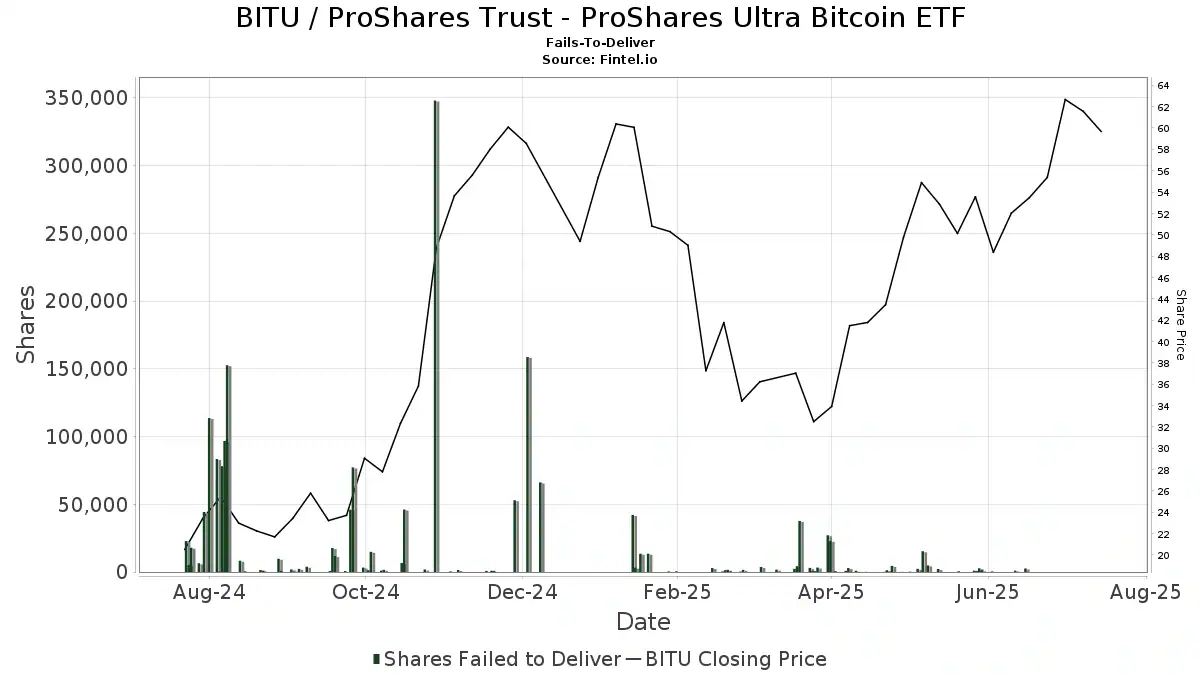
Image Source: Fintel
The ProShares Ultra Bitcoin ETF (BITU) leads the pack of leveraged Bitcoin ETFs and gives investors a powerful tool to increase their cryptocurrency exposure. This fund, launched April 1, 2024, has become a major force in the digital asset ETF space.
BITU key features
BITU aims for twice (2x) the daily performance of the Bloomberg Bitcoin Index before fees and expenses. The ETF does not buy Bitcoin directly — it uses futures and swaps to achieve its leveraged exposure.
The fund puts at least 80% of its assets into financial instruments that ProShare Advisors believes will match its daily target. This strategy lets investors:
- Get magnified exposure to Bitcoin price movements
- Access leveraged Bitcoin exposure without the large costs typically associated with direct leveraged crypto investments
- Buy and sell through regular brokerage accounts instead of specialized crypto exchanges
The fund also offers options trading, which opens up more sophisticated investment strategies. Investors should know that while BITU multiplies gains when Bitcoin prices climb, it also doubles down on losses during market drops.
BITU performance in 2025
BITU delivered impressive results throughout 2025, proving what leveraged Bitcoin exposure can do. Recent performance data shows:
- A second-quarter 2025 return of 57.57% (NAV) and 57.30% (Market Price)
- Year-to-date returns of 10.62% (NAV) and 10.52% (Market Price) as of Q2 2025
- One-year returns of 105.30% (NAV) and 104.68% (Market Price)
The total return in the last year including dividends hit 204.64%. The average annual return since the fund started stands at 54.14%.
The fund’s metrics show it tracks its underlying index closely, with a correlation of 1.00 and a beta of 2.04 in Q2 2025. This confirms BITU delivers on its promise of 2x daily Bitcoin returns.
| Period | BITU (NAV) | BITU (Market Price) | Bitcoin Index |
| Q2 2025 | 57.57% | 57.30% | 30.36% |
| YTD | 10.62% | 10.52% | 15.16% |
| 1 Year | 105.30% | 104.68% | 79.03% |
BITU pricing and fees
The fund keeps a competitive 0.95% expense ratio, which is reasonable given the complexity of maintaining a leveraged position. BITU has grown to manage about $1.18 billion in assets, with 21.93 million shares outstanding.
As of August 8, 2025, BITU traded at:
- Market price: $57.96
- NAV: $57.93
- 52-week range: $18.56 – $68.43
The fund pays monthly dividends with a recent $0.9662 dividend declared on August 1, 2025. The twelve-month trailing dividend is $3.73, yielding about 6.43%.
Active traders will appreciate BITU’s liquidity — it averages about 2.03 million shares traded daily over a 10-day period. The 30-day median bid-ask spread sits at just 0.03%, which means tight trading conditions and lower transaction costs.
While BITU offers strong opportunities, leveraged ETFs work best for short-term trading rather than long-term holding. The daily reset means returns over longer periods might not match the simple multiple of index returns, especially when markets get volatile.
Volatility Shares 2x Bitcoin Strategy ETF (BITX)

BITX made history on June 27, 2023, becoming the first ETF to offer leveraged exposure to cryptocurrency in the United States. This fund has proven to be a strong vehicle for amplified Bitcoin returns.
BITX key features
BITX works as a 2x leveraged, daily resetting Exchange-Traded Fund with a clear goal: to deliver twice the daily performance of Bitcoin. The fund uses a futures-based approach to achieve this leveraged exposure:
- Daily rolling of Bitcoin futures from the front-month (M1) contract to the second-month (M2) contract
- Daily adjustment of holdings to maintain consistent 2x exposure
- Addition or subtraction of futures contracts to accommodate new investments or redemptions
BITX is registered under the U.S. Investment Company Act of 1940, unlike direct cryptocurrency investments. This gives investors familiar regulatory protections. The structure comes with several benefits:
- Reports gains and losses via standard IRS 1099 forms
- No K-1 issuance requirement
- Not subject to non-resident withholding on publicly traded partnerships
The fund utilizes cash-settled Bitcoin futures contracts traded on CFTC-registered exchanges, currently the Chicago Mercantile Exchange. Cash, cash-like instruments, and high-quality securities serve as collateral to complement these positions.
BITX performance in 2025
BITX rewarded investors who predicted Bitcoin’s upward trajectory throughout 2025. The fund’s performance data shows:
| Period | Total Return | Category Average |
| YTD (as of Aug 2025) | 24.58% | 8.03% |
| 1-Month | 15.00% | 14.95% |
| 3-Month | 43.74% | 39.10% |
| 1-Year | 101.32% | 35.71% |
The second quarter of 2025 stood out with BITX posting a 57.10% return. This followed an exceptional first quarter of 2024, when the fund surged 133.96%.
Patient investors who held BITX through volatile periods saw substantial rewards. The fund has delivered an average annual return of 109.57% since its inception, outpacing its category average and traditional investment vehicles by a wide margin.
BITX pricing and fees
BITX manages about $2.85 billion in assets, making it one of the largest leveraged cryptocurrency ETFs available. The fund’s key metrics as of August 8, 2025, include:
- Share price: $60.88
- 52-week range: $20.91 – $72.80
- Shares outstanding: 46.32 million
- NAV (Net Asset Value): $61.58
The fund charges an annual fee of 1.85%, which comes out of the fund’s assets daily (about 0.005%). All costs included bring the total expense ratio to 2.38%.
BITX offers monthly dividend distributions with strong income potential. The trailing twelve-month dividend is $5.93, yielding an impressive 9.74%. Recent distributions show:
- July 29, 2025: $0.61
- June 26, 2025: $0.54
- May 28, 2025: $0.52
BITX works best as a short-term trading vehicle rather than a long-term investment. The fund’s daily reset feature means returns over periods longer than one day might vary significantly from simply doubling Bitcoin’s performance, especially during highly volatile periods. This requires active management and regular position monitoring.
T-Rex 2X Long Bitcoin Daily Target ETF (BTCL)
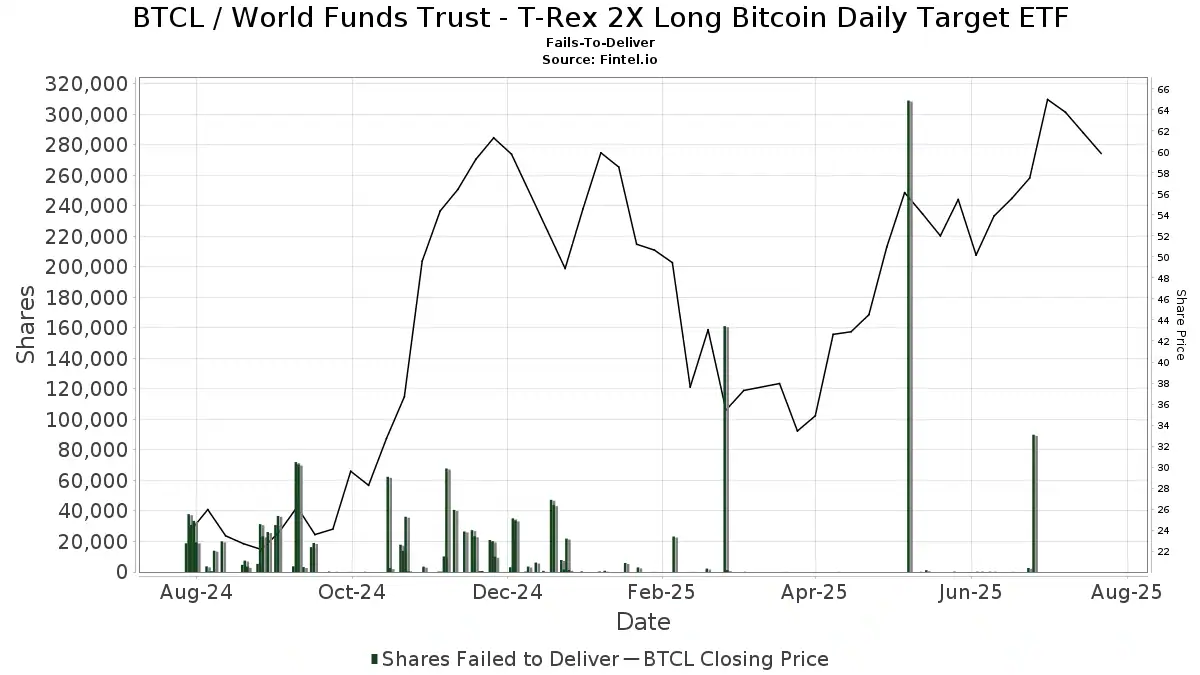
Image Source: Fintel
The T-Rex 2X Long Bitcoin Daily Target ETF (BTCL) launched on July 10, 2024, and quickly became a strong player in the growing space of leveraged Bitcoin ETFs. This fund gives investors another way to double their Bitcoin exposure through a regulated investment vehicle.
BTCL key features
T-Rex 2X Long Bitcoin Daily Target ETF wants to provide daily investment results that match twice (200%) the daily performance of spot Bitcoin, before fees and expenses. The fund uses these strategies to reach its goals:
- Invests in swap agreements with major global financial institutions that provide 200% daily exposure to Bitcoin
- Allocates at least 80% of its net assets to these swap agreements
- The core team manages a focused portfolio with only 9 holdings to efficiently handle its leveraged exposure
Tuttle Capital Management created BTCL for knowledgeable investors who understand the potential risks of seeking daily leveraged returns. The fund clearly states it does not try to achieve its investment objective beyond a single trading day.
The biggest challenge with BTCL lies in its significant risks. The fund will lose money if Bitcoin stays flat for longer than a day. Additionally, investors could lose their entire principal in just one day if Bitcoin drops more than 50%.
BTCL performance in 2025
BTCL delivered impressive results in 2025 for investors who predicted Bitcoin’s upward movement correctly. Here are the fund’s performance metrics:
| Period | Return |
| 1 Month | 11.71% |
| 6 Month | 23.00% |
| YTD | 25.13% |
| 1 Year | 148.57% |
The fund’s total return in the last year, including dividends, reached an exceptional 202.03%. Since its launch, BTCL has maintained an average annual return of 134.38%, showing its potential to generate substantial gains during bullish Bitcoin markets.
BTCL reached its 52-week high of $69.81 on December 17, 2024, when Bitcoin surged above $100,000. The fund hit its 52-week low of $18.91 on September 6, 2024, which illustrates how volatile leveraged cryptocurrency investments can be.
BTCL pricing and fees
BTCL traded at $60.85 on August 8, 2025, with a 2.25% daily drop. Here are the fund’s key metrics:
- Assets under management: $51.47 million
- Shares outstanding: 1.05 million
- Daily trading range: $60.53 – $61.90
- 10-day average trading volume: 66,625 shares
The fund’s expense ratio of 0.95% makes it one of the more budget-friendly options among leveraged Bitcoin ETFs. This competitive fee structure helps investors maximize their returns while keeping costs low.
BTCL also provides income through dividends. The fund announced a $2.12 per share dividend for 2025, paid on December 26, 2025, with an ex-dividend date of December 24, 2025. This creates a yield of about 3.48%, giving investors both growth potential and income.
The fund’s holdings show 120.55% of assets in its top 10 investments, which reflects its focused approach and use of derivatives to achieve leverage. This concentration helps with efficient management but increases certain risks compared to more diversified funds.
BTCL works best for short-term traders rather than long-term investors because of its leveraged nature. The daily reset feature means long-term performance might not simply double Bitcoin’s returns. Investors need to actively manage and monitor their positions regularly.
CoinShares Valkyrie Bitcoin Futures Leveraged Strategy ETF (BTFX)

CoinShares Valkyrie Bitcoin Futures Leveraged Strategy ETF (BTFX) has grown faster than expected since its launch on February 21, 2024. This ETF gives investors a chance to maximize returns in the volatile cryptocurrency market through its unique Bitcoin futures leverage approach.
BTFX key features
BTFX stands out with its straightforward investment strategy. The fund wants to deliver twice (2x) the daily performance of the S&P CME Bitcoin Futures Excess Return Index. BTFX does not buy Bitcoin directly but tries to profit from price increases in Bitcoin Futures Contracts each day.
The fund’s investment strategy has these core elements:
- Invests mainly in cash-settled bitcoin futures contracts that trade only on CFTC-registered exchanges (currently CME)
- Maintains at least 80% of net assets in Bitcoin Futures Contracts
- Employs cash, cash-like instruments, and high-quality securities as collateral
- A team with expertise in both traditional and digital assets actively manages the strategy
The fund clearly states it does not try to meet its investment goals beyond a single day. This makes BTFX better suited for short-term trading instead of long-term investment.
BTFX performance in 2025
BTFX showed remarkable results in 2025 and beat its category average across several timeframes:
| Period | BTFX Return | Category Average |
| YTD | 17.32% | 8.03% |
| 1-Month | 17.75% | 14.95% |
| 3-Month | 46.21% | 39.10% |
| 1-Year | 105.19% | 35.71% |
The fund’s total return in the last year with dividends reached 199.39%. Since its launch, BTFX has maintained an average annual return of 83.78%. These numbers show strong performance during Bitcoin’s bull runs.
BTFX reached its 52-week peak at $72.53 on December 17, 2024, right when Bitcoin crossed $100,000. The fund hit its 52-week bottom at $18.62 on September 6, 2024. These swings show how volatile leveraged crypto investments can be.
BTFX pricing and fees
BTFX traded at $61.46 on August 8, 2025, down 1.17% for the day. Here are the fund’s key numbers:
- Assets under management: $17.10 million
- NAV (Net Asset Value): $62.81
- 52-week trading range: $18.62 – $72.53
- Shares outstanding: 265,000
- 10-day average trading volume: 10,000 shares
The fund has a total expense ratio of 1.86%, which puts it in the middle range for leveraged Bitcoin ETFs. This fee reflects the complexity of maintaining leveraged positions through futures contracts.
BTFX’s portfolio on August 7, 2025 showed this mix:
- 101.57% in Bitcoin Future Aug 25 (about $32 million)
- 46.70% in deposits with broker for short positions
- 45.49% in additional deposits with broker
Given its smaller AUM of $17.10 million compared to BITU or BITX, BTFX carries higher liquidity risk. Traders should check bid-ask spreads carefully before entering large positions. The fund’s futures-based structure also means it may experience roll costs when contracts expire monthly, which can create a modest drag on returns over time.
Direxion Daily Bitcoin 2x Shares ETF (BITD)
Direxion Daily Bitcoin 2x Shares ETF (BITD) brings the well-known Direxion brand of leveraged ETFs into the Bitcoin space. Direxion has decades of experience managing leveraged and inverse ETFs across equities and commodities, and BITD applies that same daily-reset methodology to Bitcoin.
BITD key features
BITD seeks daily investment results equal to 200% of the daily performance of the benchmark Bitcoin price index. Like its peers, the fund resets its leverage exposure each trading day, meaning it is designed for active traders rather than buy-and-hold investors.
The fund uses swap agreements and Bitcoin futures contracts to achieve its 2x target. Direxion’s established infrastructure for managing leveraged products gives BITD a structural advantage in execution and collateral management compared to newer entrants.
Investors should note that BITD carries the same compounding risk as all daily-reset leveraged ETFs. In choppy, sideways markets, the daily reset can erode returns even when Bitcoin ends the period flat. This is sometimes called “volatility decay” and is a key reason these funds suit short-term tactical positions.
BITD performance and fees
BITD has tracked Bitcoin’s major moves closely since launch, delivering amplified gains during Bitcoin’s rally above $100,000 in late 2024 and its subsequent push toward $120,000. Check the provider’s website for current pricing and the most recent performance data, as figures update daily.
The fund’s expense ratio sits in line with other Direxion leveraged products. Direxion’s brand recognition and operational history make BITD a credible option for traders already familiar with leveraged ETF mechanics. For investors comparing non-leveraged Bitcoin ETF options alongside leveraged ones, the best Bitcoin ETFs guide covers the full spectrum.
Grayscale 2x Bitcoin Trust (GBTCX)
Grayscale is one of the most recognized names in institutional cryptocurrency investment, and GBTCX extends that brand into the leveraged ETF space. The fund targets twice the daily return of Bitcoin, following the same daily-reset structure used by BITU and BITX.
GBTCX key features
GBTCX benefits from Grayscale’s deep relationships with institutional counterparties and its experience managing large-scale Bitcoin exposure. The fund uses swap agreements referencing Bitcoin’s spot price to achieve its 2x daily objective.
One distinguishing factor is Grayscale’s brand trust among institutional investors. Many family offices and registered investment advisors who already hold GBTC (Grayscale’s spot Bitcoin ETF) may find GBTCX a natural extension for tactical leveraged exposure within the same fund family.
GBTCX performance and fees
GBTCX has delivered amplified returns during Bitcoin’s bull phases, consistent with its 2x daily mandate. The fund’s expense ratio reflects Grayscale’s premium positioning. Check the provider’s website for current AUM, NAV, and the latest performance figures, as these change with Bitcoin’s price movements.
Investors considering GBTCX should weigh Grayscale’s institutional credibility against the fund’s fee structure relative to lower-cost alternatives like BITU or BTCL. For traders who want leveraged exposure with a 3x multiplier instead of 2x, the 3x leveraged Bitcoin ETF guide covers those higher-risk options in detail.
Hashdex Bitcoin Futures 2x ETF (HBTF)
Hashdex brings a crypto-native perspective to the leveraged ETF space. The firm focuses exclusively on digital asset investment products, and HBTF reflects that specialization with a 2x daily Bitcoin futures strategy.
HBTF key features
HBTF seeks to deliver twice the daily performance of Bitcoin futures contracts. Hashdex’s crypto-first research team actively manages the fund’s futures roll strategy, aiming to minimize roll costs that can drag on returns in contango markets.
The fund’s crypto-native management team is a differentiator. Unlike traditional asset managers who have added Bitcoin products to existing lineups, Hashdex built its entire business around digital assets. This focus can translate into more nuanced futures management and faster adaptation to changing market microstructure.
HBTF performance and fees
HBTF has participated in Bitcoin’s major price moves since launch. The fund’s expense ratio is competitive within the leveraged Bitcoin ETF category. Check the Hashdex website for current NAV, AUM, and performance data before investing, as these figures shift with Bitcoin’s daily price action.
HBTF suits investors who want leveraged Bitcoin exposure from a manager with deep crypto expertise. However, its smaller AUM relative to BITU or BITX means liquidity is a consideration for larger position sizes. Always check the bid-ask spread before executing trades in smaller leveraged ETFs.
Comparison Table: All 7 Leveraged Bitcoin ETFs
The table below summarizes the key metrics for all seven leveraged Bitcoin ETFs covered in this article. Use it to compare expense ratios, AUM, leverage structure, and launch dates side by side before making a decision. Note that performance figures reflect data available through mid-2025 — check each fund’s provider page for the most current numbers.
| ETF | Ticker | Leverage | Expense Ratio | AUM (approx.) | Launch Date |
| ProShares Ultra Bitcoin ETF | BITU | 2x Daily | 0.95% | ~$1.18B | Apr 2024 |
| Volatility Shares 2x Bitcoin Strategy ETF | BITX | 2x Daily | 1.85% (2.38% total) | ~$2.85B | Jun 2023 |
| T-Rex 2X Long Bitcoin Daily Target ETF | BTCL | 2x Daily | 0.95% | ~$51.5M | Jul 2024 |
| CoinShares Valkyrie Bitcoin Futures Leveraged | BTFX | 2x Daily | 1.86% | ~$17.1M | Feb 2024 |
| Direxion Daily Bitcoin 2x Shares ETF | BITD | 2x Daily | Check provider | Check provider | 2024 |
| Grayscale 2x Bitcoin Trust | GBTCX | 2x Daily | Check provider | Check provider | 2024 |
| Hashdex Bitcoin Futures 2x ETF | HBTF | 2x Daily | Check provider | Check provider | 2024 |
Key takeaway from the comparison: BITX holds the largest AUM at roughly $2.85 billion, giving it the deepest liquidity pool among the seven. BITU and BTCL tie on the lowest expense ratio at 0.95%, making them the most cost-efficient options for frequent traders. BTFX, BITD, GBTCX, and HBTF are smaller funds — suitable for investors who prefer specific issuer relationships but require careful attention to bid-ask spreads before trading.
All seven funds use a daily-reset structure. None of them are designed for passive, long-term holding. The compounding effect of daily resets means that in volatile, sideways markets, all seven funds can lose value even when Bitcoin’s net price change over the period is flat or slightly positive. Active position management is non-negotiable with any of these products.
How to Choose the Right Leveraged Bitcoin ETF in 2026
Choosing between these seven funds comes down to four practical factors: liquidity, cost, issuer credibility, and your holding period. Here is how to apply each criterion.
Step 1 — Match liquidity to your position size
BITX ($2.85B AUM) and BITU ($1.18B AUM) handle large trades with minimal slippage. Their daily volumes run into the millions of shares. For position sizes above $50,000, stick to these two. BTCL, BTFX, BITD, GBTCX, and HBTF are smaller — fine for retail-sized trades but check the bid-ask spread before entering.
Step 2 — Compare expense ratios for your trading frequency
If you trade in and out of leveraged Bitcoin ETFs multiple times per month, the 0.95% expense ratio on BITU and BTCL saves meaningful money versus the 1.85–2.38% on BITX or the 1.86% on BTFX. Over a full year of active trading, that difference compounds. For occasional tactical positions, the fee gap matters less than liquidity.
Step 3 — Understand the futures roll cost
All seven funds use Bitcoin futures or swaps. When Bitcoin futures trade in contango (futures price above spot), rolling contracts from one month to the next creates a cost drag. Hashdex’s crypto-native team specifically focuses on minimizing this drag. BITX and BITU have the longest track records for managing roll costs at scale — check each fund’s prospectus for its roll methodology before committing capital.
Step 4 — Set a maximum holding period before you buy
Daily-reset leveraged ETFs are not buy-and-forget instruments. A practical rule: decide your exit target before entering. Many active traders use these funds for holding periods of one day to two weeks. Holding through a major Bitcoin correction without a stop-loss can result in losses that significantly exceed what a simple 2x multiple of Bitcoin’s drawdown would suggest, due to volatility decay.
Investors who want exposure to Bitcoin without leverage — or who are comparing these products against Canadian alternatives — can review the Canadian spot Bitcoin ETF guide for a different risk profile.
Conclusion
The seven leveraged Bitcoin ETFs covered here — BITU, BITX, BTCL, BTFX, BITD, GBTCX, and HBTF — all target 2x daily Bitcoin returns through regulated, exchange-listed structures. For most active traders in 2026, BITX and BITU stand out as the clearest choices: BITX leads on AUM and liquidity, while BITU and BTCL offer the lowest expense ratios at 0.95%.
The right fund depends on your position size and trading frequency. Large traders should prioritize BITX or BITU for their deep liquidity. Cost-conscious traders who trade frequently will benefit most from BITU or BTCL’s lower fees. Investors who prefer Grayscale’s or Direxion’s institutional track record may find GBTCX or BITD a better fit despite their smaller AUM.
One rule applies to all seven: these are short-term trading tools, not long-term holdings. The daily reset mechanism means that holding through extended volatile periods can produce returns that diverge significantly from a simple 2x multiple of Bitcoin’s performance. Set your entry and exit targets before you trade, monitor positions actively, and size positions to reflect the amplified downside risk.
Bitcoin’s supply cap of 21 million coins — with roughly 19 million already mined — remains a structural argument for long-term price appreciation. But leveraged ETFs are tactical instruments designed to capture short-term directional moves, not to hold through multi-year cycles. Use them accordingly, and always check the provider’s website for current NAV, AUM, and expense ratio data before executing any trade.
Key Takeaways
- All seven funds target 2x daily Bitcoin returns using futures contracts or swap agreements — none hold Bitcoin directly.
- BITX is the largest with roughly $2.85 billion in AUM, offering the deepest liquidity for large trades.
- BITU and BTCL have the lowest expense ratios at 0.95%, making them the most cost-efficient for frequent traders.
- Daily reset = volatility decay risk. In choppy markets, these funds can lose value even when Bitcoin’s net move is flat over the period.
- BITX was the first leveraged crypto ETF in the US, launching June 27, 2023. BITU followed in April 2024.
- Monthly dividends are a feature of BITU, BITX, and BTCL — useful for income-oriented traders who also want leveraged Bitcoin exposure.
- Smaller funds (BTFX, BITD, GBTCX, HBTF) carry higher liquidity risk — always check bid-ask spreads before trading.
- These are short-term instruments. Set entry and exit targets before buying. Do not hold through major Bitcoin corrections without a stop-loss strategy.
- Futures roll costs can create a drag on returns in contango markets — review each fund’s roll methodology in its prospectus.
Frequently Asked Questions
What is the best leveraged Bitcoin ETF in 2026?
BITX (Volatility Shares 2x Bitcoin Strategy ETF) is the best leveraged Bitcoin ETF for most traders in 2026, based on its roughly $2.85 billion AUM and the deepest daily liquidity among all seven options. BITU (ProShares Ultra Bitcoin ETF) is the best choice for cost-conscious traders, with a 0.95% expense ratio that is among the lowest in the category. The right answer depends on your position size and trading frequency — larger traders benefit from BITX’s liquidity, while frequent traders save more with BITU’s lower fees.
How does a 2x leveraged Bitcoin ETF work?
A 2x leveraged Bitcoin ETF delivers twice the daily percentage return of Bitcoin using futures contracts or swap agreements — not by holding Bitcoin directly. If Bitcoin gains 3% in a single trading day, the ETF targets a 6% gain. If Bitcoin falls 3%, the ETF targets a 6% loss. The fund resets its leverage exposure at the end of each trading day, which means multi-day returns do not simply equal 2x Bitcoin’s return over that period. In volatile markets, this daily reset can cause returns to diverge significantly from the expected 2x multiple — a phenomenon called volatility decay.
Are leveraged Bitcoin ETFs safe for long-term investing?
No — leveraged Bitcoin ETFs are not designed for long-term investing. Every fund covered in this article explicitly states in its prospectus that it does not seek to achieve its 2x objective beyond a single trading day. Over weeks or months, the daily reset mechanism can cause significant return erosion in choppy markets, even if Bitcoin’s net price change is positive. These products suit short-term tactical trades, typically held for one day to two weeks. Investors seeking long-term Bitcoin exposure should consider spot Bitcoin ETFs or direct Bitcoin ownership instead.
What is the expense ratio for leveraged Bitcoin ETFs?
Expense ratios for leveraged Bitcoin ETFs range from 0.95% to 2.38% annually among the seven funds covered here. BITU and BTCL charge the lowest at 0.95%. BITX charges 1.85% in management fees, with a total expense ratio of 2.38% when all costs are included. BTFX sits at 1.86%. BITD, GBTCX, and HBTF — check each provider’s current prospectus for their exact figures, as these can change. Higher expense ratios compound over time and reduce net returns, making fee comparison a critical step before choosing a fund.
Can I lose all my money in a leveraged Bitcoin ETF?
Yes — in theory, you can lose your entire principal in a single trading day if Bitcoin drops more than 50%, because a 2x leveraged ETF would then lose more than 100% of its value. In practice, fund managers have circuit breakers and collateral structures that make a total single-day wipeout rare, but the risk is real and disclosed in every fund’s prospectus. Beyond single-day risk, extended Bitcoin bear markets can cause leveraged ETFs to lose the majority of their value through a combination of amplified losses and volatility decay. Position sizing and stop-loss orders are essential risk management tools when trading these products.
Do leveraged Bitcoin ETFs pay dividends?
Yes — BITU, BITX, and BTCL all pay monthly dividends. BITU’s trailing twelve-month dividend was $3.73 per share, yielding approximately 6.43%. BITX’s trailing twelve-month dividend was $5.93, yielding approximately 9.74%. BTCL announced a $2.12 per share dividend for 2025, yielding about 3.48%. These dividends come from the income generated by the funds’ collateral holdings (typically short-term Treasuries or money market instruments), not from Bitcoin itself. Dividend amounts vary month to month and are not guaranteed.
References
- CoinShares Valkyrie BTFX ETF page
- Stock Analysis — BTCL ETF data
- CNBC Markets — ETF quotes
- Hashdex ETF data
- CNBC Markets — BTCL quote
- CNBC Markets — BTFX quote
- SEC EDGAR — BITX filing
- Financial Times — ETF data
- MarketWatch — BTCL fund page
- Yahoo Finance — BTFX performance
- Stock Analysis — BTFX ETF data
- MarketWatch — BTFX fund page
- Morningstar — BTFX ETF quote
- ProShares BITU fact sheet (PDF)
- US News — BITU ETF profile