


MSTR stock’s value has shot up by over 2,200% since August 2020. This growth started right after the company began investing in Bitcoin.
The stock’s performance has grabbed investors’ attention worldwide. MicroStrategy — now trading as Strategy — holds the title of largest corporate Bitcoin owner, with holdings currently worth over $58 billion. The gains come with serious volatility, though. The company reported a $5.9 billion unrealized loss in Q1 2025 because of Bitcoin’s price swings.
Table of Contents

Years of tracking this stock confirm that MSTR’s price moves hand in hand with Bitcoin. That relationship creates opportunities to profit but also brings amplified downside risk. Some active traders generate weekly income between $17,000 and $18,000 through covered calls and rolling trades on MSTR positions. Whether MSTR belongs in your portfolio really comes down to how much volatility you can stomach and what you’re trying to achieve. This guide helps you work through that decision.
Traders who want to understand the broader Bitcoin derivatives landscape may also find this Bitcoin options trading guide a useful companion read.
Understanding MSTR Stock and Its Business Model

Image Source: Stopsaving.com
MicroStrategy started out far from the Bitcoin world that now shapes its public image. Michael J. Saylor, Sanju Bansal, and Thomas Spahr founded the company in 1989. They built it as a business intelligence (BI) and analytics provider. The company grew steadily through the 1990s by securing data-mining contracts with major clients like McDonald’s. They went public in 1998.
MicroStrategy’s software and analytics roots
The company’s core business was developing specialized software that helps organizations analyze internal and external data to make better business decisions. Their main platform includes several capabilities:
Interactive dashboards and scorecards
Automated report distribution
Ad hoc queries and data visualization tools
Thresholds and alerts for business monitoring
This technology base put MicroStrategy up against major players in the business intelligence space, including SAP AG Business Objects, IBM Cognos, and Oracle Corporation’s BI Platform. The company nearly went bankrupt from an accounting scandal in 2000, bounced back, and gradually moved toward cloud analytics.
Their software architecture stands out with its relational online analytical processing (ROLAP) approach. Users can drill anywhere in databases down to transaction-level details. The system’s single common metadata layer streamlines maintenance and keeps reports consistent across the organization.
Bitcoin as a treasury asset
August 2020 changed everything. MicroStrategy announced it would invest $250 million of its cash reserves into Bitcoin. This bold move, led by Saylor, kicked off a dramatic transformation. The decision stemmed from concerns about falling cash returns, a weakening dollar, and broader macro uncertainty.
MicroStrategy didn’t stop at one purchase. The company kept buying Bitcoin aggressively through a combination of cash reserves, zero-coupon convertible notes, and new equity issuance. By December 2024, it owned 423,650 bitcoins worth approximately $42.43 billion — the largest corporate position in existence. That figure has since grown. Strategy currently holds around 582,000 bitcoins, funded through billions in convertible debt and equity raises.
Saylor describes the approach as a “leveraged bet on digital gold.” The company introduced the concept of “bitcoin yield” — measuring the increase in Bitcoin holdings per diluted share over time — to help investors track how efficiently the treasury strategy grows their per-share Bitcoin exposure.
Rebranding to Strategy and what it means
On February 5, 2025, MicroStrategy announced it would do business under a new name: Strategy. The company now describes itself as “the world’s first and largest Bitcoin Treasury Company.” The analytics division continues operating under the Strategy One brand, offering AI-powered business intelligence tools, but Bitcoin acquisition is clearly the primary mission.
Saylor explained the rename directly: “Strategy is one of the most powerful and positive words in the human language. It represents a simplification of our company name to its most important, strategic core.”
The renaming reflects how completely the company’s identity has shifted. Software revenue runs at roughly $463 million annually — a stable but modest figure. Bitcoin holdings, currently valued at approximately $58 to $63 billion depending on Bitcoin’s price at any given moment, dwarf that figure entirely. For most investors today, buying MSTR stock means buying Bitcoin exposure through a traditional brokerage account.
The company joined the Nasdaq-100 index on December 23, 2024, cementing its position as a bridge between conventional equity markets and cryptocurrency. That inclusion brought a wave of new institutional buying from index-tracking funds, which added meaningful liquidity and visibility to the stock.
How to Buy MSTR Stock Step-by-Step

Image Source: Mind Studios
Buying MSTR stock follows the same process as any publicly traded company. Strategy lists on the NASDAQ under the ticker MSTR, and most major online brokers give you access. Here is the full process from account setup to confirmed purchase.
Open a brokerage account
You need a brokerage account with NASDAQ access before buying any shares. Many online brokers — including Fidelity, Charles Schwab, Interactive Brokers, and TD Ameritrade — offer commission-free trading on MSTR. Canadian investors can access the stock through platforms like Questrade or Wealthsimple Trade, which also offer USD trading accounts.
These factors should guide your broker selection:
Trading fees (many now offer zero-commission trading on US equities)
Platform usability and mobile app quality
Research tools and educational resources
Customer service reputation
Account minimums and maintenance fees
The account opening process includes:
Completing an online registration form with your personal information
Providing identification documents for verification purposes
Answering questions about your investment experience and financial situation
Setting up two-factor authentication and security credentials
Most brokers verify and approve accounts within minutes, though some take a few business days depending on the platform and your jurisdiction.
Search for the MSTR ticker
Finding MSTR stock is straightforward once your brokerage account is funded:
Log into your brokerage account
Go to the trading or markets section of the platform
Type “MSTR” or “Strategy” into the search bar
Confirm the exchange shown is NASDAQ before proceeding
The results display MSTR’s current stock price alongside daily price movement, volume, and market capitalization. Most platforms also show simple charts and analyst price targets directly on the quote page.
Choose order type and number of shares
This is where you make your key decisions about share quantity and how your order executes.
Two main order types apply:
Market Order: Buys shares immediately at the best available price. This prioritizes speed over precision and typically executes in seconds during market hours.
Limit Order: Sets a maximum price per share. The order only executes when MSTR’s price reaches or falls below your specified level. This gives better price control but may not fill if the stock doesn’t hit your target.
Given MSTR’s high daily volatility — the stock can move 5% to 10% in a single session when Bitcoin makes big moves — limit orders often make more sense than market orders. A limit order placed 1% to 2% below the current price can save meaningful money on a volatile day.
Your share quantity should reflect your total investment budget, the desired portfolio weighting for MSTR, and your risk tolerance given the stock’s Bitcoin linkage. Most modern brokers now offer fractional shares, so you can invest a specific dollar amount rather than buying whole shares.
Review and place your order
Before confirming your purchase, review these details:
Verify the ticker symbol (MSTR) is correct — not a similar-sounding ETF or fund
Double-check the order type (market or limit)
Confirm the quantity of shares or dollar amount
Review any applicable fees or currency conversion charges
For limit orders, verify your price threshold before submitting
Market orders confirm within seconds. Limit orders notify you once your price conditions are met and the order executes. After buying, track both MSTR-specific news and Bitcoin price movements — the two are closely linked and both affect your position’s value.
What to Know Before You Invest in MSTR Stock
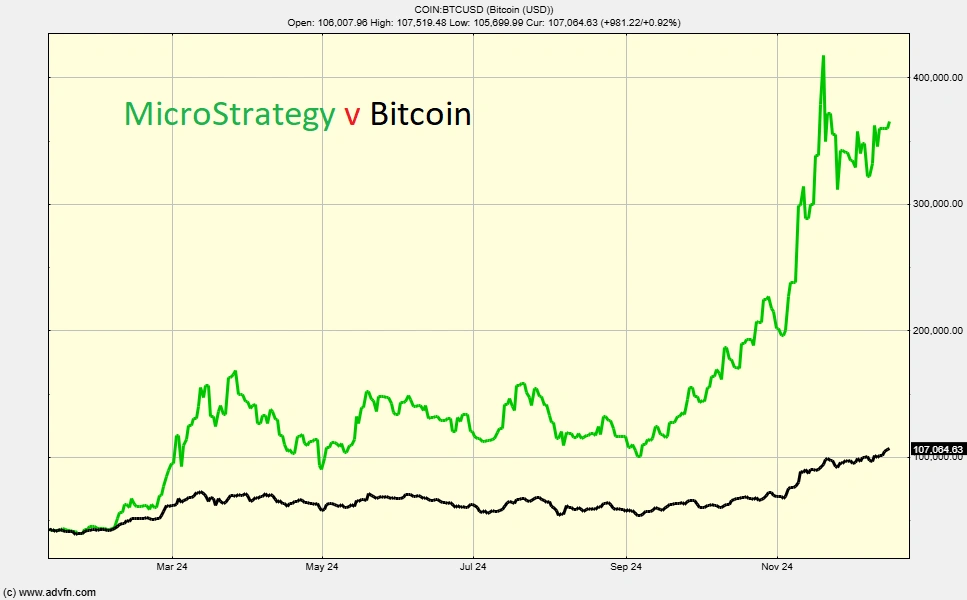
Image Source: Seeking Alpha
MSTR stock carries characteristics that make it fundamentally different from most equities. Before committing capital, you need a clear understanding of the volatility profile, Bitcoin correlation mechanics, and the company’s split history.
Volatility due to Bitcoin exposure
MSTR’s 30-day historical volatility runs at approximately 113% — more than twice Bitcoin’s 55% over the same period. These amplified swings happen because the company’s balance sheet consists of over 99.5% Bitcoin. There is almost no other asset class acting as a buffer.
Analysts describe this as “torque” to Bitcoin price movements — a mechanism that magnifies both gains and losses relative to holding Bitcoin directly. MSTR’s volatility accounts for roughly 87.5% of its total returns, which makes it significantly riskier than typical equity investments.
Critics like economist Peter Schiff have raised bankruptcy concerns if Bitcoin prices were to collapse sharply. While that is a tail-risk scenario, the math is worth understanding: Bitcoin would need to fall approximately 80% from its current level for Strategy’s assets to drop below its total debt obligations. That gives the company a wider buffer than most bear-case analyses suggest, but the risk is not zero.
MSTR stock price correlation with BTC
The relationship between MSTR and Bitcoin is strong but imperfect. Over the past year, MSTR has maintained a correlation of 0.52 to Bitcoin with a beta of approximately 1.77 — meaning MSTR tends to move roughly 1.77 times Bitcoin’s percentage change in either direction.
Annual correlation figures are more stable, running between 0.60 and 0.69. Shorter windows show wider variation: quarterly figures range from 0.50 to 0.75, while monthly readings swing between 0.30 and 0.90. Weekly correlation can range from -0.80 to nearly 1.0. This explains why MSTR sometimes diverges sharply from Bitcoin over a few days even though the long-term trend tracks closely.
One data point worth noting: MSTR shows a 0.77 correlation with Bitcoin over a rolling 12-month period, compared to just 0.35 with the SPDR S&P Software and Services ETF. Since late 2020, the cumulative MSTR-to-Bitcoin correlation has reached 0.92. For practical purposes, MSTR stock behaves far more like a Bitcoin proxy than a software stock.
MSTR stock split history and implications
Strategy completed a 10-for-1 stock split through a stock dividend on August 8, 2024. This was the company’s third split since its 1998 IPO. Here is the full history:
August 8, 2024: 10-for-1 forward split
July 31, 2002: 1-for-10 reverse split
January 27, 2000: 2-for-1 forward split
One MSTR share held before January 2000 equals two shares today after adjusting for all splits.
The 2024 split dropped the share price from roughly $1,450 to approximately $145, making the stock more accessible to retail investors and eligible for employee stock compensation plans. The split didn’t change Strategy’s underlying value — it simply divided the same ownership into more, cheaper units. However, splits like this typically attract fresh retail interest, and MSTR was no exception in the weeks following August 2024.
Analyzing MSTR’s Financial Health
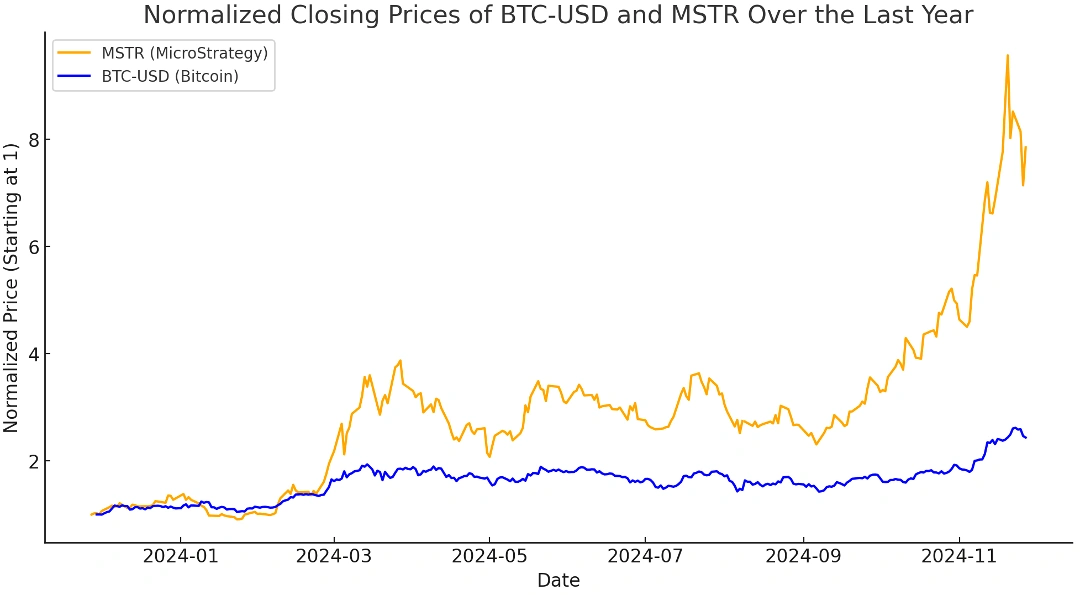
Image Source: Yahoo Finance
Reading MSTR’s balance sheet requires a different framework than traditional equity analysis. The shift from a pure software business to a Bitcoin treasury has rendered conventional metrics like price-to-earnings ratios largely irrelevant for this stock.
Revenue from software vs. Bitcoin gains
The software segment generates approximately $463 million in annual revenue, providing a stable but modest operational foundation. That figure represents less than 1% of the company’s total asset base once Bitcoin holdings are included.
Quarterly reports now break down into two main revenue categories:
Enterprise software revenue ($134.2 million in Q4 2024)
Bitcoin impairment recovery or charges (e.g., $24.3 million recovery in Q4 2024)
The software segment grew approximately 10% year-over-year in 2024, which is healthy for that business in isolation. However, it is dwarfed by the Bitcoin position, which currently accounts for over 99% of total company assets. Traditional valuation multiples simply don’t apply here — Strategy trades primarily on Bitcoin price expectations, not earnings.
Recent earnings and losses
The earnings reports illustrate extreme Bitcoin-driven volatility in financial results. Q1 2025 produced a $5.9 billion unrealized loss tied to Bitcoin price moves. Other quarters — particularly when Bitcoin ran above $90,000 — generated multi-billion dollar unrealized gains.
The financial statements now feature three layers:
Traditional operating income or loss from the software business
Bitcoin impairment charges (non-cash accounting losses under prior GAAP rules)
Gains from any Bitcoin sales executed during the period
Note that the FASB updated fair value accounting rules for crypto assets, effective from fiscal years beginning after December 15, 2024. Under the new standard, companies like Strategy must mark their Bitcoin holdings to fair value each reporting period, with changes flowing through the income statement. This change makes MSTR’s reported earnings even more volatile than before, reflecting Bitcoin price moves in real time rather than only recording losses on the way down.
Interest expenses on convertible notes used to fund Bitcoin purchases currently run at approximately $200 million annually — a fixed cost that exists regardless of Bitcoin’s price. That’s worth factoring into any break-even analysis.
Is MSTR a good stock to buy?
The answer depends almost entirely on your view of Bitcoin’s long-term trajectory. Investors bullish on Bitcoin may prefer MSTR for several practical reasons:
Bitcoin exposure through traditional brokerage accounts — no crypto wallet or exchange required
Potential tax treatment advantages compared to direct cryptocurrency ownership in certain jurisdictions
Professional management of a large-scale Bitcoin treasury with disciplined acquisition strategies
Options market access — MSTR has one of the most liquid options chains among crypto-adjacent equities, enabling covered call income strategies
These benefits come with real trade-offs. The leverage effect means MSTR typically moves more than Bitcoin itself — both in rallies and selloffs. You are also taking on the risks of the underlying software business, the convertible debt structure, and management execution. MSTR currently trades at a 5% to 15% premium to its net asset value (Bitcoin holdings minus debt), which reflects market confidence in Saylor’s strategy but also means you’re paying a markup over the raw Bitcoin exposure.
Strategy’s inclusion in the Nasdaq-100 has drawn more institutional capital into the stock, which improves liquidity and may reduce some extreme intraday volatility compared to earlier years. But this remains a high-conviction, high-risk position — not a stable store of value.
How MSTR Options and Covered Calls Work
One advantage MSTR has over direct Bitcoin ownership is a highly liquid options market. Active traders use MSTR options to generate income or hedge their exposure. The covered call strategy — selling call options against shares you already own — is particularly popular with MSTR holders.
Generating weekly income with covered calls
Because MSTR’s implied volatility is extremely high (often above 100%), the premiums on short-dated call options are substantial. Traders with 100-share blocks regularly sell weekly or biweekly calls and collect $500 to $1,500 per contract depending on the strike price chosen and market conditions. Traders holding larger positions — say, 1,000 to 1,500 shares — report weekly income in the $17,000 to $18,000 range through disciplined rolling strategies.
The mechanics are straightforward: you own MSTR shares, then sell call options at a strike price above the current market price. If the stock stays below your strike by expiration, you keep the premium as income. If it rises above the strike, your shares get called away at the strike price — you still profit, but you cap your upside on that position.
Rolling trades to manage assignments
When MSTR spikes sharply and your short calls go deep in the money, rolling the position — buying back the near-term contract and selling a further-dated one at a higher strike — lets you collect additional premium while avoiding assignment. This works best in high-volatility environments, which MSTR provides consistently.
For investors new to options on crypto-adjacent stocks, the Bitcoin options trading guide covers the foundational concepts you need before trading MSTR calls and puts.
Managing Risk and Setting Goals
MSTR’s extraordinary volatility means risk management isn’t optional — it’s the difference between a profitable strategy and a devastating loss. The stock’s near-total dependence on Bitcoin price means a single macro event can move your position 20% or more in hours.
Broadening your portfolio
MSTR’s Bitcoin concentration makes it among the most volatile stocks on any major US exchange. Adding it to a portfolio without balancing offsets that concentration risk against everything else you own.
Practical steps:
Keep your MSTR allocation smaller than your typical single-stock positions — many experienced traders cap it at 2% to 5% of total portfolio value
Balance the position with assets that have low or negative correlation to Bitcoin, such as utilities, consumer staples, or short-duration bonds
Avoid doubling up on Bitcoin risk by holding both MSTR and direct Bitcoin or Bitcoin ETFs at large allocations simultaneously
Investors interested in Bitcoin exposure with built-in income generation may also explore Canadian spot Bitcoin ETFs, which offer a more direct and regulated route to Bitcoin with lower individual stock risk.
Understanding your risk tolerance
Be honest about how you react to large drawdowns before buying MSTR. The stock fell over 75% from its November 2021 peak to its 2022 lows — a steeper drop than Bitcoin itself during the same period. If a 50% portfolio drawdown on this position would cause you to sell in panic, the position size is too large.
MSTR suits investors with high risk tolerance and a multi-year time horizon best. If you are within five years of retirement, need this capital for a specific goal, or lose sleep over 10% daily swings, other investments will serve you better. For those who can tolerate the swings, even a small MSTR allocation has historically provided significant portfolio-level alpha.
Setting long-term vs. short-term goals
Your investment timeframe shapes how you should handle MSTR entirely. Long-term holders — those with a 5 to 10-year horizon — can ride out the inevitable drawdowns because Bitcoin’s long-term trajectory has historically rewarded patient holders. Short-term traders need strict stop losses because MSTR can move against you faster than almost any other large-cap stock.
Key technical levels to monitor: support has historically formed around $250 and $297, while resistance has appeared near $335 and $383. These levels shift as Bitcoin’s price evolves, so check current charts before placing any trade. Price action beyond these ranges — in either direction — often accelerates rapidly due to options market gamma effects and short covering.
Define your goal before you buy. Are you seeking long-term Bitcoin appreciation through equity markets? Are you writing covered calls for monthly income? Are you making a short-term trade on a Bitcoin catalyst? Each goal implies a different position size, holding period, and exit strategy.
Tracking MSTR Stock Performance and Forecasts
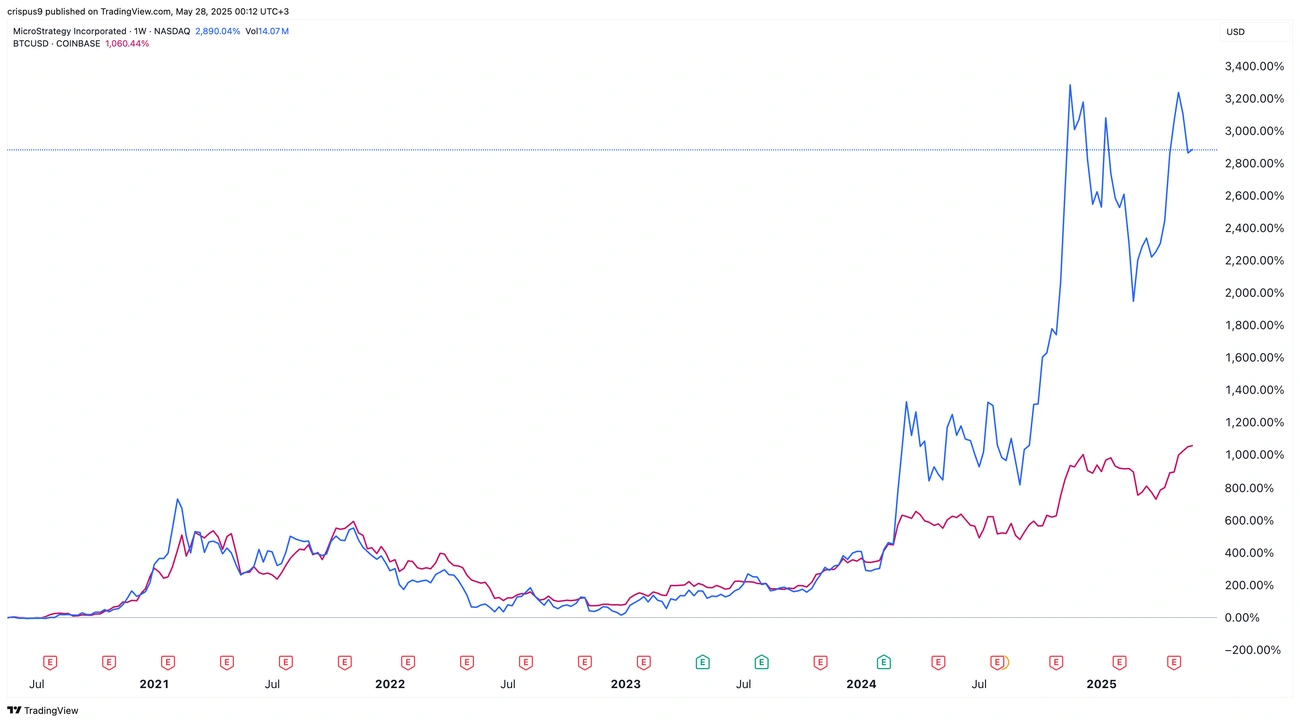
Image Source: BanklessTimes
Monitoring MSTR effectively requires watching both technical signals and Bitcoin market sentiment simultaneously. Traditional equity analysis covers only part of the picture.
MSTR stock price prediction trends
Analyst price targets for MSTR currently range from $175 to $650, reflecting the deep disagreement about Bitcoin’s trajectory. Technical analysis across most major charting platforms shows a “buy” or “strong buy” signal on the 1-week timeframe at present, though these signals can flip quickly when Bitcoin trends reverse.
Historical performance data gives longer-term context: MSTR has delivered an annualized return of approximately 36% over the past decade, versus roughly 11% for the S&P 500 over the same period. That outperformance is real, but it came alongside a maximum drawdown exceeding 75% — a figure that filters out most conservative investors before they ever see those long-run gains.
The stock showed a 30-day volatility figure of 13.45% on a rolling basis, which compounds into the massive annual volatility numbers discussed earlier. Understanding both figures helps you size positions appropriately.
MSTR news and market sentiment
Short interest in MSTR has periodically hit record highs, signaling that a meaningful portion of the market remains bearish. High short interest creates a potential short squeeze dynamic — if Bitcoin rallies sharply and MSTR spikes, short sellers covering their positions can accelerate the move dramatically.
The stock’s technical chart has shown a “Cup and Handle” pattern on multiple occasions, which traders read as a bullish continuation signal. Watch resistance levels at $393, $404, and $416 — breakouts above these zones have historically preceded strong multi-week rallies. Support at $250 has acted as a floor during deeper Bitcoin corrections.
Strategy’s continuing Bitcoin purchases are also a recurring price catalyst. Each time Saylor announces a new acquisition — often disclosed through SEC 8-K filings within days of purchase — MSTR stock typically reacts positively in the short term. Following Strategy’s official filings and Saylor’s public announcements gives you advance notice of these catalysts before they’re widely reported.
MSTR vs. Buying Bitcoin Directly: Key Differences
Many investors face a direct choice: buy MSTR stock or buy Bitcoin itself. Both give you Bitcoin price exposure, but they work differently in practice.
Accessibility and account type
MSTR trades in standard brokerage accounts, including IRAs and tax-sheltered accounts, where direct Bitcoin ownership typically isn’t available. That’s a real advantage for investors who want Bitcoin exposure inside a retirement account without navigating crypto exchanges or self-custody wallets.
Buying Bitcoin directly through an exchange gives you the cleanest 1:1 exposure but requires setting up a crypto account, managing wallet security, and dealing with exchange-specific risks. Investors who prefer to keep everything within regulated brokerage infrastructure often find MSTR a practical alternative.
Leverage and premium
MSTR provides implicit leverage because the company borrows money to buy more Bitcoin than its software cash flows alone could support. When Bitcoin rises, MSTR typically rises more. When Bitcoin falls, MSTR falls more. This is the core trade-off versus owning Bitcoin directly.
Additionally, MSTR trades at a premium to its Bitcoin net asset value — currently in the 5% to 15% range. You are paying above the raw Bitcoin value per share. Direct Bitcoin ownership carries no such premium. That premium can shrink or expand based on market sentiment, which adds another variable beyond Bitcoin’s price.
Tax and reporting differences
In most jurisdictions, MSTR stock follows standard equity tax treatment — capital gains on shares held over one year qualify for long-term rates, and losses are reportable in the same way as any other stock. Direct Bitcoin ownership typically triggers different reporting requirements, including tracking cost basis across individual transactions. Consult a qualified tax advisor for guidance specific to your situation, as rules vary significantly between the US, Canada, and other jurisdictions.
Conclusion
Trading MSTR stock means taking a position on Bitcoin through an equity wrapper — with leverage built in. Strategy’s core software business generates approximately $463 million in annual revenue, but that is not what moves the stock. Bitcoin’s price is the dominant driver, and MSTR amplifies every move in both directions.
The numbers tell the story clearly: MSTR has delivered roughly 2,200% returns since August 2020, outperforming even Bitcoin itself over that stretch. It has also posted a $5.9 billion unrealized loss in a single quarter. Both outcomes are possible when you hold this stock — sometimes in the same year.
Smart MSTR investing requires three things. First, a genuine conviction that Bitcoin will appreciate over your chosen time horizon. Second, position sizing that reflects the stock’s 113% annualized volatility — not the same sizing you’d use for a blue-chip equity. Third, a defined exit plan or income strategy, whether that’s a long-term hold, covered call writing, or strict stop-loss levels for shorter-term trades.
MSTR stock suits investors who want Bitcoin exposure within traditional market infrastructure, who can tolerate severe short-term drawdowns, and who have a multi-year perspective. For those investors, the leveraged Bitcoin treasury model has generated exceptional long-term returns. For everyone else, the risk-reward profile demands very careful thought before putting capital to work.
Frequently Asked Questions About MSTR Stock
Is MSTR stock a good buy right now?
MSTR stock is worth buying only if you are bullish on Bitcoin’s long-term price appreciation, since the stock functions primarily as a leveraged proxy for Bitcoin. Strategy currently holds approximately 582,000 bitcoins and trades at a 5% to 15% premium to its Bitcoin net asset value. If Bitcoin rises significantly over your holding period, MSTR typically outperforms Bitcoin itself. If Bitcoin falls sharply, MSTR will fall further.
Why does MSTR stock move more than Bitcoin?
MSTR moves more than Bitcoin because Strategy uses debt financing to buy more Bitcoin than its cash flows alone could fund, creating built-in financial leverage. The company’s beta to Bitcoin is approximately 1.77, meaning it moves roughly 1.77 times Bitcoin’s percentage change. This leverage amplifies gains when Bitcoin rises and losses when Bitcoin falls, which is why MSTR’s 30-day historical volatility runs at around 113% versus Bitcoin’s approximately 55%.
What is the MSTR stock price prediction?
Current analyst price targets for MSTR range from $175 to $650, reflecting the wide divergence in Bitcoin price forecasts. Technical indicators on most major platforms currently show a buy signal on the 1-week timeframe. The stock’s price trajectory depends almost entirely on Bitcoin’s performance, so any meaningful MSTR forecast must first take a position on Bitcoin’s direction over the forecast period.
How many Bitcoin does MicroStrategy (Strategy) own?
Strategy currently holds approximately 582,000 bitcoins, making it the largest corporate Bitcoin holder in the world. The company funded these purchases through cash reserves, zero-coupon convertible notes, and equity issuances. Each new acquisition is disclosed through an SEC 8-K filing, usually within a few days of the purchase date.
Can MSTR stock go to zero?
MSTR stock could theoretically approach zero only if Bitcoin collapsed by approximately 80% from current levels and triggered debt default, since Strategy’s liabilities would then exceed its assets. The company has structured its convertible debt with staggered maturities and no direct margin calls tied to Bitcoin’s price, which provides more financial resilience than a typical leveraged crypto position. That scenario remains a severe tail risk rather than a near-term probability.
What is the difference between MSTR stock and a Bitcoin ETF?
MSTR stock is a share in an operating company whose primary asset is Bitcoin, with leverage built in through debt financing. A Bitcoin ETF tracks Bitcoin’s price directly without leverage and without corporate debt risk. MSTR typically outperforms Bitcoin ETFs in bull markets due to its leverage, but it also carries greater downside exposure and trades at a premium to its underlying Bitcoin value — a premium that Bitcoin ETFs don’t carry.
References
- CompaniesMarketCap — MicroStrategy Stock Split History
- Investopedia — What Does Strategy (Formerly MicroStrategy) Do?
- Nasdaq — MicroStrategy’s 10-for-1 Stock Split: 10 Things You Need to Know
- Nasdaq — The Fundamental Problem With MicroStrategy’s Bitcoin Buying Plan
- CoinDesk — MSTR vs. BTC: Which Is the Better Bitcoin Bet?
- AInvest — Strategy MSTR Stock Hits Record Short Interest
- MarketWatch — MSTR Analyst Estimates
- BrokerChooser — How to Buy MicroStrategy Shares
- The Motley Fool — How to Invest in MicroStrategy Stock
- StockInvest — How to Buy MicroStrategy Stock
- CoinCodex — How to Buy MSTR Stock
- VanEck — Deconstructing Strategy: MSTR Premium, Leverage, and Capital Structure
- AInvest — MicroStrategy Bankruptcy Risk Analysis
- Bitwise Investments — Is MicroStrategy a Risk for Bitcoin?
- Forbes — What Is the Correlation Between BTC and MSTR?
- MarketWatch — MicroStrategy Stock Surges as Bitcoin Regains $100K
- Strategy — MicroStrategy Announces 10-for-1 Stock Split
- Axios — MicroStrategy Stock Split and Crypto
- CoinSpeaker — MicroStrategy Stock Price Analysis and Forecast
- IG — A Lesson in FOMO: MicroStrategy Stock Price Continues to Soar
- MacroAxis — MSTR Investment Advice
- IG UK — How to Buy MicroStrategy Stock: An Investment Guide
- TradingView — MSTR Stock Charts and Analysis
- FinanceCharts — MSTR Stock Performance
- PortfoliosLab — MSTR Historical Returns and Volatility


