
Best High Dividend ETFs Canada 2026: 8 Picks Ranked by Yield, Payout Frequency & Total Return
If you’re hunting for the best high dividend ETFs in Canada in 2026, here’s the uncomfortable truth most listicles won’t tell you: the highest yield on the page is rarely the best investment. A 9% yield that goes nowhere for three years loses to a 3% yield attached to a portfolio that actually grows. This guide ranks eight Canadian-listed dividend ETFs on yield, payout frequency, fees, tax treatment, and total return — so you pick the one that fits your goal instead of chasing the biggest number.

TL;DR — Our Verdict on the Best High Dividend ETFs in Canada for 2026
- Best overall: XEI (iShares S&P/TSX Composite High Dividend Index ETF). ~3.5% trailing yield, 0.23% MER, monthly payouts, ~30% total return over the past year.
- Best maximum monthly income: HDIV (Hamilton Enhanced Canadian Covered Call ETF). Indicated yield ~9%, paid monthly — but with a ~1.88% expense ratio, leverage up to 1.25×, and distributions that are mostly option income and return of capital, not eligible dividends.
- Best dividend-growth screen: CDZ (iShares S&P/TSX Canadian Dividend Aristocrats Index ETF). Only holds companies that raised their dividend five straight years. Modest ~3.1% yield; the quality screen is the feature.
- Best conservative monthly income: ZWC (BMO Canadian High Dividend Covered Call ETF). ~6.1% trailing yield, monthly, no leverage.
- Best for total return: ZDY (BMO US Dividend ETF). Only ~1.5% yield, but US exposure and ~14% annualized return since inception.
Short version: if you want cash flow today, go HDIV or ZWC. If you want to be wealthier in ten years, go XEI, VDY, or ZDY. Don’t pick one and expect it to do the other’s job.
This article is for educational purposes only and is not financial advice. Yields and fees cited are trailing/indicated figures from public sources as of late September–early October 2026 and move with prices. Always check the current fund facts before investing.
How We Ranked Them
Most “best dividend ETF” lists rank by trailing yield. That’s lazy — it rewards funds that pay you your own capital back and punishes funds whose price went up, since yield falls as price rises.
Here’s what we actually weighed:
- Distribution yield (trailing 12 months) — what the fund actually paid per unit over the last year, divided by current price.
- Payout frequency — monthly vs. quarterly. Matters if you’re living off the income; barely at all if you’re reinvesting.
- Fees (MER/expense ratio) — a 9% yield with a ~1.9% fee drag is really a 7% yield wearing a costume.
- Total return — price appreciation plus distributions. The number that determines whether you’re actually richer.
- Tax character of distributions — eligible Canadian dividends get the dividend tax credit in a non-registered account; option income and return of capital don’t.
- Strategy risk — leverage, concentration, active vs. passive.
We excluded US-listed funds (withholding-tax drag, currency hassle) and anything without real assets or a track record. Every number below was verified against public sources in October 2026.
The 8 Best High Dividend ETFs in Canada — Compared
| ETF | Ticker | Trailing yield* | MER / expense ratio | Payout | AUM (approx.) | Key focus |
|---|---|---|---|---|---|---|
| iShares S&P/TSX Composite High Dividend Index ETF | XEI | ~3.5% | 0.23% | Monthly | ~$4.3B | Broad Canadian high-dividend |
| Vanguard FTSE Canadian High Dividend Yield Index ETF | VDY | ~2.9% | 0.22% | Monthly | ~$9.1B | High-yield blue chips |
| iShares S&P/TSX Canadian Dividend Aristocrats Index ETF | CDZ | ~3.1% | 0.66% | Monthly | ~$1.2B | Dividend-growth streaks |
| BMO Canadian Dividend ETF | ZDV | ~2.7% | 0.39% | Monthly | ~$1.9B | Rules-based dividend portfolio |
| BMO Canadian High Dividend Covered Call ETF | ZWC | ~6.1% | 0.72% | Monthly | ~$2.5B | Covered calls, no leverage |
| iShares Canadian Financial Monthly Income ETF | FIE | ~4.4% | ~0.75–0.85% | Monthly | ~$1.3B | Financials-sector income |
| Hamilton Enhanced Canadian Covered Call ETF | HDIV | ~9.2% (indicated) | ~1.88% | Monthly | ~$1.9B | 1.25× levered covered calls |
| BMO US Dividend ETF | ZDY | ~1.5% | 0.33% | Monthly | ~$0.9B | US dividend stocks |
*Trailing-12-month yields from public data sources as of early October 2026, except HDIV (indicated). Yields move daily with unit prices.
1. XEI — iShares S&P/TSX Composite High Dividend Index ETF: Best Overall
If I could own exactly one Canadian dividend ETF and never touch it again, it would be XEI. Managed by BlackRock Asset Management Canada, it tracks the S&P/TSX Composite High Dividend Index: 50–75 Canadian stocks screened for above-median dividend yield, capped at 5% per issuer and 30% per sector, with a monthly review that boots any company cutting its dividend.
The numbers: ~3.5% trailing yield, 0.23% MER, monthly distributions, ~$4.3B in assets, ~30% total return over the past year. Highest yield among the plain-vanilla Canadian dividend index funds, and almost entirely eligible Canadian dividends — the tax-advantaged kind. The catch is concentration: banks, pipelines, telecoms, energy. It’s a bet on Canada’s cash cows, not diversification.
Pros: Highest trailing yield among the core dividend index ETFs; 0.23% MER; monthly payouts; huge liquidity; eligible-dividend tax treatment.
Cons: Heavy Canada concentration; yield tied to bank/energy dividend cycles.
Not for you if: You need 6%+ cash flow to live on, or you want US/international exposure.
2. VDY — Vanguard FTSE Canadian High Dividend Yield Index ETF: Best Low-Cost Blue-Chip Pick
VDY is the biggest dividend ETF in the country (~$9.1B in assets) and the cheapest at a 0.22% MER, managed by Vanguard Investments Canada. It tracks the FTSE Canada High Dividend Yield Index — 61 of Canada’s highest-yielding large caps, tilted toward financials (~55%) and energy (~30%).
Note the ~2.9% trailing yield looks modest partly because the fund crushed it — ~34% total return over the past year mechanically compresses yield (payout ÷ price; price ran, payouts didn’t). After a 25%+ year-to-date run, one mid-2026 review called VDY “overvalued and concentrated” — a warning about chasing it today, not a sell signal. Genuine tax edge: the index excludes REITs, so nearly all distributions qualify as eligible Canadian dividends.
Pros: Lowest MER on the list (0.22%); ~$9.1B in assets; monthly payouts; tax-efficient eligible dividends; best 1-year total return (~34%).
Cons: Concentrated in banks and energy; yield compressed after the big run; monthly payouts vary.
Not for you if: You want steady, predictable cheques, or you’re already overweight Canadian banks.
3. CDZ — iShares S&P/TSX Canadian Dividend Aristocrats Index ETF: Best Dividend-Growth Screen
CDZ, also from BlackRock, ignores today’s yield and screens for behaviour: to get in, a company must have raised its ordinary cash dividend every year for at least five consecutive years. Roughly 97–103 holdings, monthly distributions, ~$1.2B in assets.
Yield is a middle-of-the-road ~3.1% trailing, and the 0.66% MER is the steepest among the plain index funds — you’re paying real money for the quality screen. The payout ratio (~34–51%) suggests dividends are well covered. But at 0.66%, the fund must beat XEI or VDY by ~0.4% a year just to break even for you — and over the past year it returned ~16% total versus ~34% (VDY) and ~30% (XEI). A quality tilt, not a return guarantee.
Pros: Quality screen (5+ years of consecutive raises); ~100 holdings; monthly payouts; well-covered payout ratio.
Cons: 0.66% MER is steep for an index fund; unremarkable yield; recent total return lags cheaper rivals.
Not for you if: You’re fee-sensitive.
4. ZDV — BMO Canadian Dividend ETF: Best Actively-Screened Alternative to VDY
ZDV is BMO Asset Management’s answer to VDY: a rules-based portfolio of ~50–63 Canadian dividend payers selected on three-year dividend growth, current yield, and payout ratio, with a liquidity screen. No index — the methodology is the strategy.
At 0.39% MER it’s pricier than VDY or XEI, and the ~2.7% trailing yield is the lowest of the Canadian core group. The case for it: a slightly different sector mix than the pure yield-chasers (more materials — Barrick, Agnico Eagle in the top 10), and it fits if you already hold BMO income funds like ZWC. But ~29% one-year total return, while excellent, was achieved cheaper by VDY and XEI. Hard to recommend over XEI unless you specifically want its selection process.
Pros: Rules-based dividend-growth selection; monthly payouts; different sector texture than VDY/XEI; fits BMO’s income-ETF lineup.
Cons: 0.39% MER for ~2.7% yield is a weak ratio; no compelling edge over cheaper rivals.
Not for you if: You want maximum yield per dollar of fee — XEI beats it on both.
5. ZWC — BMO Canadian High Dividend Covered Call ETF: Best Conservative Monthly-Income Play
ZWC takes a ZDV-style high-dividend portfolio and writes covered calls on it: ~6.1% trailing yield, paid monthly, no leverage. ~$2.5B in assets, 0.72% MER, managed by BMO.
This is the covered-call fund I’d point a cautious income investor toward first — simple, honest mechanics: sell calls, collect premiums, distribute monthly. No leverage, no fund-of-funds layering. Our deeper dive lives in our guide to covered-call ETFs for monthly income.
Standard covered-call trade-offs apply: the calls cap your upside in bull markets and cushion flat/down markets. The tax character is messier than a plain dividend fund — much of the distribution is option income, not eligible dividends, so after-tax yield in a non-registered account trails the headline. ZWC raised its monthly distribution to $0.12/unit in September 2026, a sign the option-writing environment has been favourable.
Pros: ~6% yield with no leverage; monthly payouts; simple, transparent strategy; large and liquid.
Cons: Covered calls cap upside in bull markets; 0.72% MER; distributions aren’t mostly eligible dividends.
Not for you if: You want maximum total return — in strong markets, the underlying stocks without the call overlay will beat this.
6. FIE — iShares Canadian Financial Monthly Income ETF: Best Financials-Sector Income Play
FIE is the oddball here, and worth understanding precisely because it’s odd. This actively managed BlackRock fund holds common shares, preferred shares, corporate bonds, and income trusts — all Canadian financials — and can borrow up to 15% of NAV through a loan facility. It targets $0.05/unit monthly but has actually been paying $0.04.
Trailing yield is ~4.4% with an MER around 0.75–0.85% (providers differ slightly; fund facts sit at the higher end). ~$1.3B in assets, monthly payouts, ~27 holdings. Honest take: the multi-asset structure smooths the ride versus owning bank stocks directly, and the cheque is steady — $0.04 like clockwork. But you’re paying active fees for a sector bet you could make cheaper, the leverage facility adds non-obvious risk, and total-return history is unremarkable. If you already own Canadian bank stocks — our Canadian bank ETF guide covers cheaper ways to do that — FIE is redundant.
Pros: Very steady $0.04/unit monthly payout; multi-asset structure smooths volatility; financials diversification (preferreds, bonds).
Cons: Active fees (~0.75–0.85% MER) for a sector bet; 15% leverage facility adds hidden risk; total return lags plain bank exposure; cut from the $0.05 target years ago.
Not for you if: You already own Canadian banks or a bank ETF.
7. HDIV — Hamilton Enhanced Canadian Covered Call ETF: Best Maximum-Yield Pick (With Eyes Open)
HDIV is the yield monster of this list: an indicated yield around 9%, paid monthly. Run by Hamilton Capital Partners, it’s a fund-of-funds holding seven Canadian sector covered-call ETFs (energy, banks, utilities, insurance, health care, tech, gold miners), with up to 1.25× leverage on top. (It was called the Hamilton Enhanced Multi-Sector Covered Call ETF until August 2025, when it was renamed — same strategy, new label.) The September 2026 distribution was $0.1950/unit, and total return has been strong — high-20s percent over the past year. The catch is cost: the headline fee is 0.65%, but you also pay the underlying ETFs’ MERs, for an all-in expense ratio around 1.88% — an enormous yearly drag the strategy must overcome.
Tax character: the distribution is mostly option income and return of capital, not eligible dividends — meaningfully worse in a taxable account. ROC: return of capital reduces your adjusted cost base, so you’ll face a bigger capital gain when you sell.
None of that makes HDIV bad — it makes it a specialist tool: maximum sustainable monthly cash flow from Canadian equities, for investors who understand the fee and tax drag and hold it in a TFSA or RRSP. Just don’t mistake 9% for a 9% dividend.
Pros: ~9% indicated yield, monthly; seven-sector diversification via underlying ETFs; strong recent total return.
Cons: ~1.88% all-in expense ratio; 1.25× leverage cuts both ways; poor tax character in taxable accounts; ROC erodes your cost base.
Not for you if: You’re fee-sensitive, hold investments in a non-registered account, or can’t stomach leveraged drawdowns.
8. ZDY — BMO US Dividend ETF: Best for Total Return (Lowest Yield on Purpose)
ZDY is the deliberate contrarian pick: the lowest yield on this list (~1.5% annualized distribution yield per BMO’s June 2026 factsheet), included to make a point. It’s BMO’s yield-weighted portfolio of ~96 US dividend payers (Broadcom, AbbVie, IBM, Apple in the top holdings), 0.33% MER, monthly distributions, ~$0.9B in assets.
Why include a 1.5%-yielder? Because ZDY’s annualized return since inception is roughly 14% — the compounding engine of the group.
Pros: US diversification the TSX can’t offer; strong long-run total return; low 0.33% MER; monthly payouts.
Cons: ~1.5% yield won’t fund anything; 15% US withholding drag outside an RRSP; no dividend tax credit; unhedged currency exposure.
Not for you if: You need income now. This is a wealth-building fund wearing a dividend costume.
How to Choose: Yield vs. Total Return, Payout Frequency & Tax
The yield trap (read this before you buy anything)
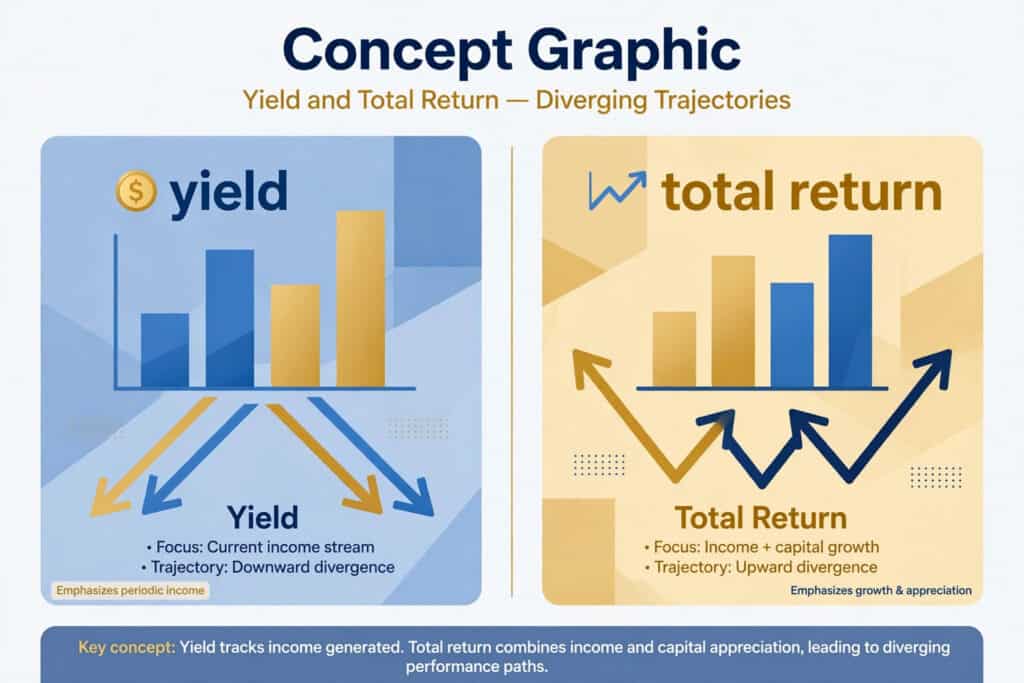
Yield is a fraction: annual distributions divided by price. It rises for two reasons — payouts went up (good) or the price went down (bad). A fund yielding 8% because its price collapsed 30% isn’t a bargain; it’s a warning. Always check why the yield is high: covered-call premiums (ZWC, HDIV), return of capital (HDIV, partly), or actual dividend growth (CDZ’s whole thesis)?
Then ask the total-return question: a 3.5% yield plus 8% price growth beats a 7% yield with zero growth — and it’s not close over a decade. Covered-call funds will almost always win the yield contest and lose the total-return contest in strong markets — that’s the price of selling your upside. Decide which game you’re playing before you pick the fund.
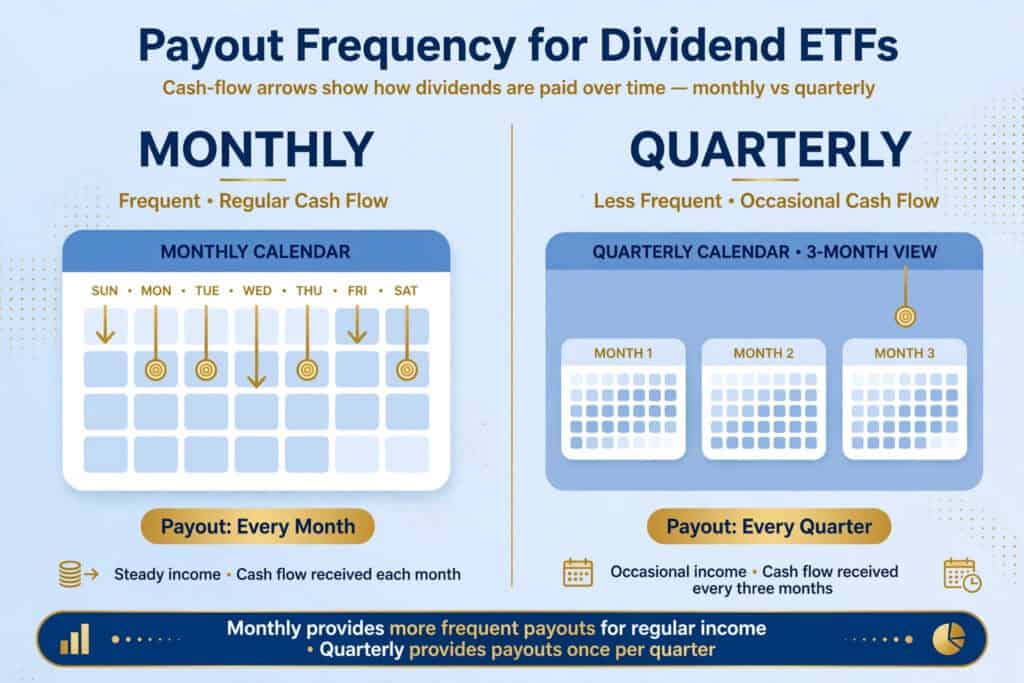
Monthly vs. quarterly payouts: does it matter?
For this list, nearly moot — all eight pay monthly. Monthly payouts matter if you’re retired and spending the distributions: twelve smaller cheques smooth budgeting versus four lumpy ones. If you’re reinvesting via DRIP, frequency is irrelevant — compounding doesn’t care about the calendar. Several of these funds support synthetic DRIPs through most Canadian brokerages, so check with yours.
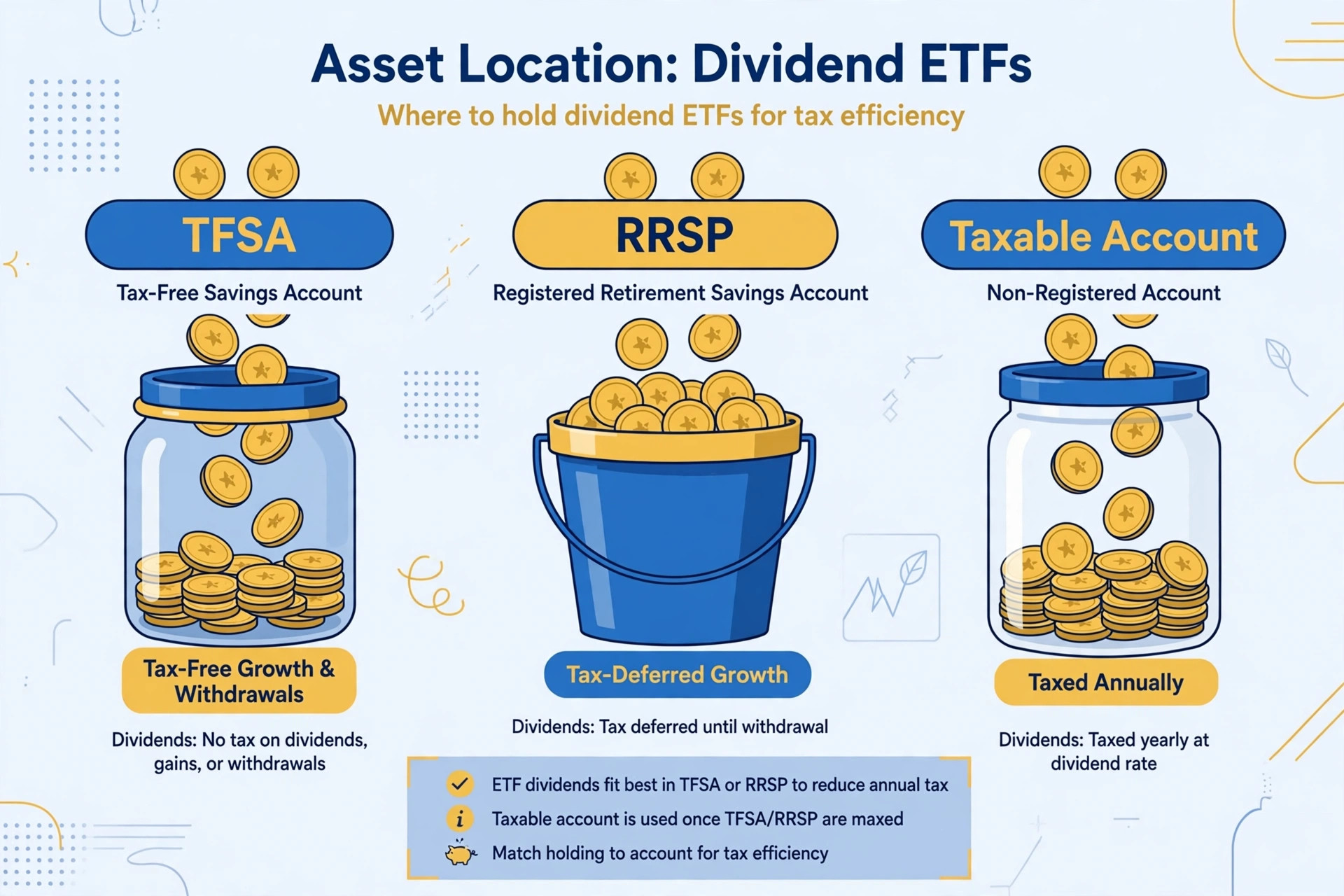
Where to hold them: TFSA vs. RRSP vs. non-registered
Asset location changes the math:
- TFSA: Everything grows tax-free, so the character of distributions doesn’t matter — HDIV’s option income and ROC are just as good here as VDY’s eligible dividends. The natural home for the covered-call funds. If you’re new to holding ETFs in a TFSA, our walkthrough on buying ETFs in your TFSA covers the mechanics (the example uses bitcoin ETFs, but account setup is identical).
- RRSP: Also shelters everything, and it’s the only account where US dividends escape withholding tax under the Canada-US treaty — ZDY belongs here, not in your TFSA (where the 15% US withholding applies and can’t be recovered).
- Non-registered (taxable): This is where distribution character bites. Eligible Canadian dividends (VDY, XEI, CDZ, ZDV) get the dividend tax credit — the most tax-efficient income in Canada outside capital gains. Covered-call distributions (ZWC, HDIV) are largely option income and ROC: taxed less favourably, with ROC grinding down your cost base until you sell.
Tax note: This is not tax advice. Dividend taxation depends on your province, income, and account type — talk to an accountant or licensed advisor before making location decisions with significant money.
A quick decision framework
- “I need maximum monthly cash flow and I understand the trade-offs” → HDIV (aggressive) or ZWC (conservative).
- “I want the best all-round Canadian dividend ETF” → XEI, with VDY as the alternative.
- “I care about dividend quality and growing payouts” → CDZ.
- “I’m investing for 10+ years and want dividends plus growth” → ZDY in your RRSP, or a VDY/XEI core with ZDY as the satellite.
- “I specifically want financials-sector income” → FIE — but compare it against a Canadian bank ETF first.
If you’re building a broader income portfolio rather than picking a single fund, our monthly Canadian dividend stocks piece pairs well with this list — individual stocks as satellites around an ETF core.
Frequently Asked Questions
What is the highest dividend ETF in Canada?
By indicated yield, the Hamilton Enhanced Canadian Covered Call ETF (HDIV) at roughly 9%, followed by the BMO Canadian High Dividend Covered Call ETF (ZWC) at roughly 6% trailing. But “highest yield” and “best” aren’t the same — both use covered-call strategies (HDIV adds leverage), which cap upside and produce distributions with worse tax treatment than plain eligible dividends.
Are Canadian dividend ETFs a good investment for monthly income?
They can be, with the right expectations. ZWC, HDIV, and FIE are engineered for monthly cash flow and deliver it reliably. Caveats: covered-call payouts vary with option premiums, high yields come with capped upside or leverage, and after-tax income in a non-registered account trails the headline yield. Keep 6–12 months of expenses in cash regardless — distributions can be cut.
How are Canadian ETF dividends taxed?
In a TFSA or RRSP, there’s no Canadian tax on distributions at all. In a non-registered account, eligible Canadian dividends (most of what VDY, XEI, CDZ, and ZDV pay) qualify for the dividend tax credit — the most tax-efficient income you can earn in Canada outside capital gains. Covered-call distributions are a mix of option income, dividends, capital gains, and return of capital, each taxed differently; ROC reduces your cost base instead of being taxed now. US dividends (ZDY) face 15% withholding outside an RRSP. Not tax advice — confirm with a tax professional.
Should I buy VDY or XEI?
Both are excellent. VDY charges 0.22% and holds 61 concentrated high-yielders (heavy banks/energy); XEI charges 0.23% and holds 50–75 names with sector caps and a monthly dividend-cut review. XEI yields more (~3.5% vs ~2.9% trailing); VDY has the stronger recent total return (~34% vs ~30%) and deeper assets. Many investors just split the difference.
Can I hold these dividend ETFs in my TFSA?
Yes — all eight are eligible for TFSAs, RRSPs, and other registered accounts. The TFSA is arguably the best home for the covered-call funds (ZWC, HDIV) because their less tax-efficient distributions are fully sheltered there. One exception: ZDY loses 15% to US withholding tax inside a TFSA, so it belongs in an RRSP instead.
Final Verdict
The best high dividend ETF in Canada for 2026 depends on which problem you’re solving — and most investors shop for yield instead of shopping for outcomes.
Income today: ZWC for a straightforward ~6% monthly stream without leverage; HDIV if you want ~9% and accept the ~1.9% fee drag, leverage risk, and messier tax character. Hold both in a TFSA or RRSP.
Wealth over time: XEI as the default all-rounder, VDY for the cheapest blue-chip exposure, CDZ if you believe dividend-growth discipline earns its fee, and ZDY in your RRSP for the US growth engine the TSX can’t replicate.
One idea to take from this article: a fund’s yield tells you what it pays, not what it earns you. Check the total return, check the MER, check what’s inside the distribution — then decide.
Educational disclaimer: this article is for informational purposes only and is not financial advice or a recommendation to buy or sell any security. Yields, MERs, asset figures, and returns were verified against public sources in early October 2026 and will change. Past performance doesn’t guarantee future results. Covered-call and leveraged strategies carry additional risks, including capped upside and amplified losses. Nothing here is tax advice — consult a licensed advisor or tax professional before making investment decisions.