
Best ETFs for Your FHSA in 2026 (Canada)
TL;DR: The best ETFs for an FHSA in Canada are decided by one question — when are you buying? Under 3 years away: capital preservation, a high-interest savings ETF like CASH.TO, and stop trying to be clever. Three to seven years: a balanced all-in-one like XBAL or VBAL, about 60% stocks and 40% bonds. Seven or more years: a growth all-in-one like XEQT or VEQT earns its risk. And before any of that, open the FHSA now, even with $0 in it — your $8,000 a year of room only starts accruing the year you open your first account. Most best ETFs for FHSA Canada 2026 lists hand you products when what you need is a date first, a ticker second.
- How We Chose the Best ETFs for an FHSA
- FHSA Mechanics: The Rules That Decide the Pick
- Why Your Timeline Drives Everything
- Under 3 Years: Capital Preservation — CASH.TO and PSA
- 3–7 Years: Balanced — XBAL and VBAL
- 7+ Years: Growth — XEQT and VEQT
- Best ETFs for FHSA Canada 2026: The Comparison Table
- The Withholding-Tax Nuance Nobody Puts in FHSA Guides
- How to Choose Your FHSA ETF
- FAQ
- Final Verdict
How We Chose the Best ETFs for an FHSA
I ranked these funds on timeline fit first, then cost, then simplicity — the order in which an FHSA decision can actually hurt you. An FHSA is not a retirement account; a fund excellent for 30 years can be terrible for 18 months.
Every fee, allocation and distribution figure was pulled from the official provider pages and fact sheets — BlackRock Canada, Vanguard Canada, Global X and Purpose Investments — and every FHSA rule from the Canada Revenue Agency (CRA). Where a published MER lags a recent fee cut, I say so and give the date, because that lag is where other sites print stale numbers as fact. Figures are dated snapshots from autumn 2026; check the current official sheet before investing.
One ticker per timeline bucket — no individual stocks, sector bets, crypto or leveraged products. A down payment fund that can halve is not aggressive, it is broken. If yield is a separate goal, see our guide to the best high dividend ETFs in Canada for 2026, but do not confuse an income portfolio with a house fund. Our Questrade vs Wealthsimple comparison for 2026 covers FHSA availability and commission-free ETF buying.
FHSA Mechanics: The Rules That Decide the Pick
Get these wrong and the ETF choice does not matter. The following are CRA rules for the First Home Savings Account, available since April 2023. Confirm your eligibility on the CRA’s FHSA pages before opening an account.
The Limits: $8,000 a Year, $40,000 Lifetime — and Room Only Starts When You Open
Your FHSA participation room in the year you open your first FHSA is $8,000, and the lifetime limit is $40,000 in contributions and RRSP transfers combined. Unused room carries forward, but only up to $8,000 — so the most you can ever contribute in one year is $16,000. Skip three years and you cannot dump in $32,000 at once. That cap is the most under-reported FHSA rule, and it is why opening early beats contributing early.
The critical point, and the CRA is explicit: room begins in the year you open your first FHSA, not before — no backdating. So if you qualify and might buy within 15 years, open the account now, even with $0, and file Schedule 15 with that year’s return so the CRA records it. Opening starts two clocks: the room clock, which helps you, and the 15-year window below. More than 15 years from buying? That second clock is a reason to pause and take advice first.
The 15-Year Window
Your maximum participation period ends on December 31 of the earliest of: the year of the 15th anniversary of opening your first FHSA, the year you turn 71, or the year after your first qualifying withdrawal. No extensions. Open at 25 in 2026 and never buy, and the deadline is December 31, 2041. Make a qualifying withdrawal in 2034 and everything must close by December 31, 2035 — and contributions after that withdrawal are not deductible.
Who Qualifies as a First-Time Home Buyer
You must be a qualifying individual when you open the account: resident in Canada, at least 18 and not older than 71, and a first-time home buyer. In CRA terms that generally means you did not, in the current calendar year or the previous four calendar years, live in a qualifying home as your principal place of residence that you owned or jointly owned — and the same test catches a home owned by your spouse or common-law partner that you lived in. That spousal wrinkle disqualifies people who assume they qualify because they never held title. Read the CRA’s worked examples before opening: an FHSA opened by a non-qualifying individual can have its registration revoked back to the opening date, with contributions losing their deduction.
FHSAs are individual, never joint. Two partners who each qualify can each build $40,000 of room — $80,000 sheltered toward one purchase. Only the holder contributes to and claims the deduction on their own FHSA, though a spouse or common-law partner can provide the funds, and the holder still claims the deduction. The CRA’s life-events pages also cover beneficiary, death and successor-holder treatment for a spouse or partner — fact-specific territory where advice beats improvisation.
The Deduction Can Wait — and the RRSP Escape Hatch
Contributions are generally deductible, like RRSP contributions, but you need not claim the deduction in the year you contribute — undeducted amounts carry forward, even past closing, which is valuable if your income is rising. Two cautions: RRSP transfers into an FHSA use FHSA room and count toward the $40,000 limit but create no new deduction, and the FHSA year is the calendar year with no 60-day grace period.
A qualifying withdrawal — under the CRA’s conditions, to buy or build a qualifying home in Canada, with a written agreement and occupancy deadlines met — comes out tax-free. Deductible in, tax-free out: no other Canadian account does both. Non-qualifying withdrawals are taxable.
If you never buy, the FHSA is not a trap: before your period ends, transfer the property directly to your own RRSP or RRIF, tax-free and without using RRSP contribution room — genuinely extra room, up to $40,000 plus growth. Withdraw the cash yourself instead and it is taxable, and the deposit uses RRSP room. Do nothing past the deadline and the account’s value is included in your income that year.
Why Your Timeline Drives Everything
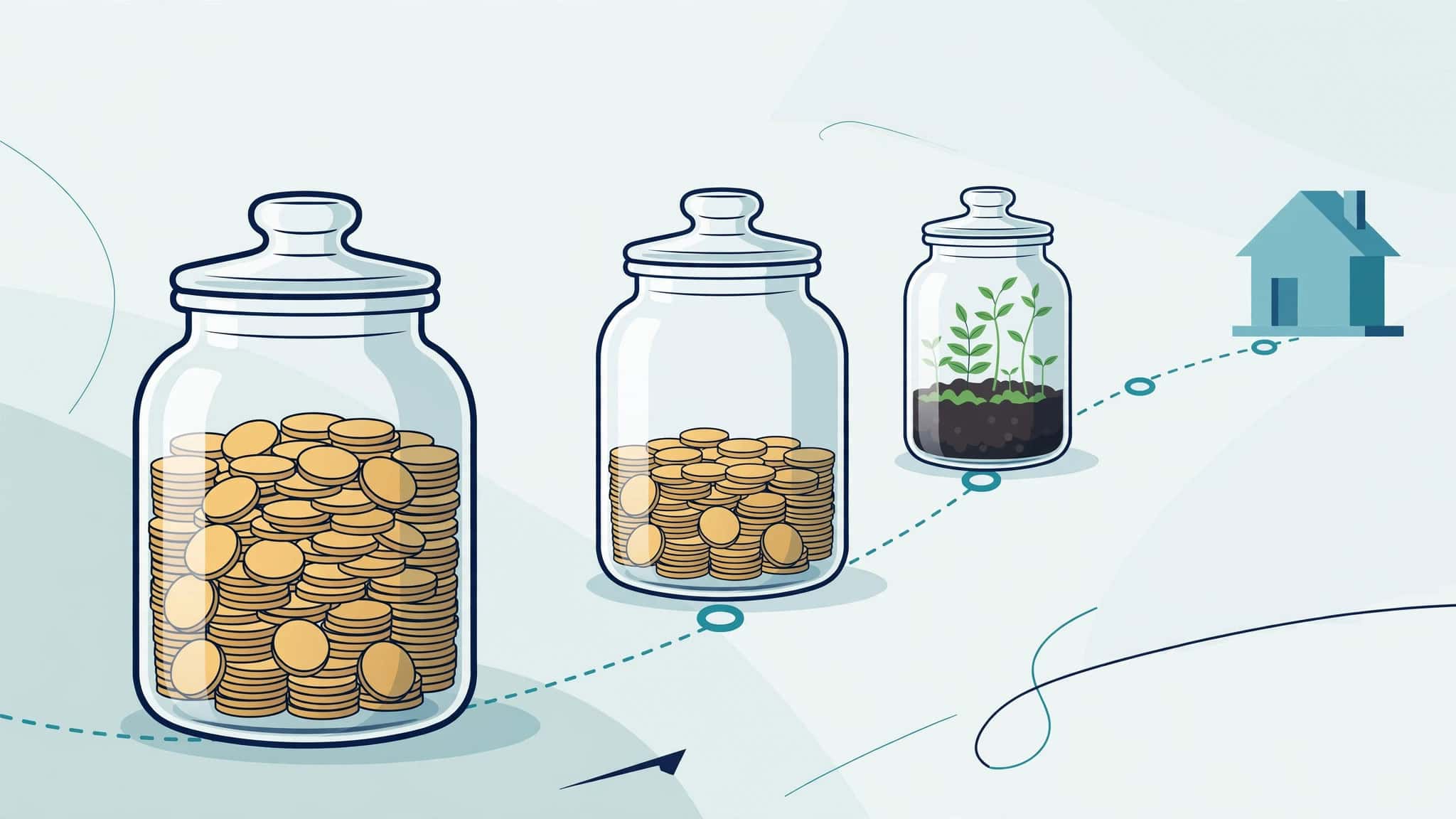
If you need $60,000 for a spring closing and the market drops 25% in the winter, there is no recovery period to hide in — you delay the purchase, buy less house, or sell at the bottom. The loss is not abstract volatility; it is a specific home on a specific date.
That asymmetry flips normal investing logic: over short horizons the main risk is a drawdown arriving just before the deadline. So the buckets below are about sequence, not personality — how much loss can this money absorb and still do its job on the date it is needed?
- Under 3 years: it cannot absorb a stock-market loss at all. Preservation first, yield second.
- 3–7 years: it can absorb a moderate drawdown and plausibly recover, but not a full equity crash at the wrong moment. Balance is the honest answer.
- 7+ years: it has time to fall and recover more than once. Growth finally earns its place.
If your date is fuzzy, use the shorter bucket. Optimism about timing is how down payments end up in 100% equity funds 14 months before closing.
Under 3 Years: Capital Preservation — CASH.TO and PSA
Global X High Interest Savings ETF (CASH)
CASH, listed as CASH.TO, is the default short-horizon FHSA holding in Canada for a reason. Global X’s stated objective: maximize monthly income while preserving capital and liquidity, investing primarily in high-interest deposit accounts with Canadian banks. As at October 30, 2026, holdings were cash accounts at National Bank (49.53%), Scotiabank (28.08% plus 4.46%) and CIBC (14.80%), with the balance at CIBC Mellon. The fund passes the deposit interest through monthly.
Costs are tiny and verified: management fee 0.10% plus applicable sales tax; published MER 0.11% (Global X ETF Facts, May 1, 2026; total fund value $6.9 billion as at March 31, 2026). The annualized distribution yield was 2.01% as at November 17, 2026, paid monthly — $0.084 per unit for October 2026. That yield floats with the Bank of Canada policy rate: you are promised the going deposit rate minus 0.11%, with daily liquidity and no lock-up. For money needed in 2028, that is exactly the right promise.
One honest caveat: CASH is not CDIC-insured — Global X states this directly, despite the underlying bank deposits. Most holders accept that trade. If deposit insurance is non-negotiable, a CDIC-insured GIC inside the FHSA, where your issuer offers one, is the alternative, at the price of lock-in.
Purpose High Interest Savings ETF (PSA)
PSA, listed as PSA.TO, is the pioneer doing the same job — Purpose Investments launched it in 2013. It holds high-interest deposit accounts with Schedule I Canadian banks plus, in its current description, short-term treasury bills, and pays monthly: $0.0896 per ETF unit for October 2026. It costs a little more — management fee 0.15%, published MER 0.17% (Purpose, as at June 30, 2026) — about $24 a year more than CASH on $40,000. Purpose’s interim statements put ETF-unit net assets at about $3.05 billion as at June 30, 2026: large and liquid. Like CASH, it is not CDIC-insured and its yield floats with policy rates.
My pick: CASH, on fee and scale. Already hold PSA? Switching to save 0.06% is motion, not progress.
3–7 Years: Balanced — XBAL and VBAL
iShares Core Balanced ETF Portfolio (XBAL)
XBAL is BlackRock Canada’s all-in-one balanced fund: eight underlying iShares ETFs, rebalanced by the manager, targeting approximately 60% equity and 40% fixed income. As at August 31, 2026, equity was about 60.1% — 26.9% U.S., 15.2% Canadian, 15.0% developed outside North America, 3.0% emerging markets — and fixed income about 39.6%, led by a Canadian universe bond ETF at 25.89%.
Management fee: 0.17%, cut from 0.18% effective December 18, 2025. Published MER: 0.18% on BlackRock’s product page as checked in September 2026 — some fact sheets still show 0.19% from an earlier period; same lag pattern, not a contradiction. Distributions are quarterly. What the fee buys is diversification, automatic rebalancing, and no decisions between now and the purchase except “keep contributing.” That last part is the actual product.
Vanguard Balanced ETF Portfolio (VBAL)
VBAL does the same job in Vanguard’s construction: seven underlying funds, a strategic target of approximately 60% equity and 40% fixed income. As at August 31, 2026, equity was about 61.6% — 27.37% U.S., 18.54% Canadian all-cap, 11.05% developed outside North America, 4.65% emerging markets — and bonds about 38.4%, led by Canadian aggregate bonds at 22.93% plus currency-hedged U.S. and global bond funds. Net assets: $5,936 million (fact sheet, September 30, 2026). Distributions are quarterly.
Management fee: 0.17%, cut from 0.22% effective November 18, 2025 — identical to XBAL today. Published MER: 0.22%, but Vanguard’s footnote says that figure is as of March 31, 2026 and does not yet reflect the full cut, so expect it to drift down. The real differences are construction: more Canada, more emerging markets, hedged foreign bonds, all-cap funds reaching into small caps.
My pick: XBAL, narrowly — lower published MER today, and a lighter Canada weight when your house, job and mortgage will already be Canadian bets. VBAL is a perfectly good pick; provider consistency is a legitimate tiebreaker.
Not for you if… your “3–7 years” just became “closing in 10 months.” Move to the preservation bucket the moment a real date exists. Balanced funds fell hard in 2022; 60/40 cushions a crash, it does not prevent one.

7+ Years: Growth — XEQT and VEQT
iShares Core Equity ETF Portfolio (XEQT)
XEQT is 100% equity, and at 7+ years that is finally defensible in an FHSA. It holds five underlying iShares ETFs. As at October 31, 2026 (BlackRock fact sheet): about 45.6% United States, 25.72% Canada, 24.14% developed outside North America, 4.48% emerging markets. Net assets: $23,418.48 million — one of Canada’s largest ETFs. Management fee: 0.17%, cut from 0.18% effective December 18, 2025; published MER 0.19%. Distributions are quarterly. Our XEQT vs VEQT for 2026 head-to-head covers the fee-drag maths in detail.
Vanguard All-Equity ETF Portfolio (VEQT)
VEQT is Vanguard’s 100% equity answer, built from four underlying funds. As at October 31, 2026 (Vanguard product page): 45.26% U.S., 30.73% Canada, 17.27% developed outside North America, 6.73% emerging markets. Its September 30, 2026 fact sheet puts net assets at $17,528 million and the look-through count at 13,936 stocks. Management fee: 0.17%, cut from 0.22% effective November 18, 2025, matching XEQT; published MER 0.22%, dated March 31, 2026 and still reflecting the old fee in part. The difference holders feel: VEQT distributes annually — for 2025, $0.76018 per unit of income plus a $0.24252 reinvested capital gains distribution. Inside an FHSA the tax-slip side does not bite, but once-a-year cash matters if you reinvest manually.
My pick: XEQT — lighter Canada weight, more developed international exposure, quarterly distributions, lower published MER today. VEQT wins if you want the heavier Canada anchor and more emerging markets. Either is sane at 7+ years; neither belongs in an FHSA with a 2027 closing date, and both will show you a frightening drawdown at some point. The plan only works if that statement does not change your behaviour.
The glidepath matters more than this head-to-head: do not ride 100% equity to the closing date. Inside roughly 3 years, shift toward balanced, then preservation — trades inside the FHSA are not taxed. De-risking a year “too early” costs a little forgone growth; a month too late can cost the house.
Best ETFs for FHSA Canada 2026: The Comparison Table
| ETF | Best timeline | Management fee / MER (verified) | Distribution | Role in FHSA |
|---|---|---|---|---|
| CASH (CASH.TO) — Global X High Interest Savings ETF | Under 3 years | 0.10% mgmt fee; 0.11% MER (ETF Facts, May 1, 2026); 2.01% annualized distribution yield as at Nov 17, 2026 — floats with Bank of Canada rates | Monthly | Capital preservation: bank-deposit interest, daily liquidity, no lock-up; not CDIC-insured |
| PSA (PSA.TO) — Purpose High Interest Savings ETF | Under 3 years | 0.15% mgmt fee; 0.17% MER (Purpose, as at Jun 30, 2026) | Monthly | Preservation alternative: Schedule I bank deposits plus short-term T-bills; not CDIC-insured |
| XBAL — iShares Core Balanced ETF Portfolio | 3–7 years | 0.17% mgmt fee (from Dec 18, 2025); 0.18% MER (BlackRock product page, checked Sep 2026) | Quarterly | Balanced: ~60% global equity / ~40% bonds, auto-rebalanced, 8 underlying ETFs |
| VBAL — Vanguard Balanced ETF Portfolio | 3–7 years | 0.17% mgmt fee (from Nov 18, 2025); 0.22% MER as of Mar 31, 2026 — predates full fee cut | Quarterly | Balanced: ~60/40, 7 underlying funds, more Canada and emerging markets, hedged foreign bonds |
| XEQT — iShares Core Equity ETF Portfolio | 7+ years | 0.17% mgmt fee (from Dec 18, 2025); 0.19% MER (fact sheet, Oct 31, 2026) | Quarterly | Full growth: 100% global equity, ~26% Canada, ~$23.4B in assets |
| VEQT — Vanguard All-Equity ETF Portfolio | 7+ years | 0.17% mgmt fee (from Nov 18, 2025); 0.22% MER as of Mar 31, 2026 — predates full fee cut | Annually | Full growth: 100% global equity, ~31% Canada, 13,936 stocks (Sep 30, 2026) |
Sources: Global X CASH product page and ETF Facts (2026); Purpose Investments PSA fund documents and October 2026 distribution release; BlackRock Canada XBAL and XEQT product pages and fact sheets (2026); Vanguard Canada VBAL and VEQT product pages and fact sheets (2026). Fees, yields, allocations and assets change — verify on the official provider page before investing.
The Withholding-Tax Nuance Nobody Puts in FHSA Guides
General education, not tax advice. U.S. dividends are generally subject to 15% withholding tax for Canadian investors under the Canada–U.S. tax treaty. In an RRSP, the treaty can exempt them — cleanest when a U.S.-listed ETF is held directly in the RRSP. The FHSA gets no such treatment, and these funds are Canadian-listed anyway, so withholding inside the fund structure is a small, unrecoverable drag on the U.S. dividend portion — the same position as a TFSA.
Do not overreact: the drag applies only to the dividend slice of a roughly 45% U.S. weight, and it is modest next to the FHSA’s headline benefits. Hold Canadian-listed ETFs in the FHSA, as every pick above is. Our guide to the best ETFs for a TFSA in Canada in 2026 covers asset location in full; our best Canadian ETFs for beginners in 2026 is the wider shortlist.
How to Choose Your FHSA ETF
Work through these in order.
- Have you opened the FHSA yet? If not, open it today — with $0 if necessary — provided you qualify and expect to buy within 15 years. No ETF pick recovers room you never started.
- What is the earliest realistic purchase date? Not the hopeful one. Under 3 years: CASH or PSA. Three to seven: XBAL or VBAL. Seven or more: XEQT or VEQT. Fuzzy date, shorter bucket.
- What if this fund is down 20% the month you need it? If the answer is “we lose the house,” you hold too much equity. Move down a bucket.
- Can you leave it alone? If weekly price-checking will move you to act, balanced beats growth even at 8 years.
- Have you planned the exit glide? Decide now: at about 3 years out, de-risk to balanced; in the final stretch, to cash-like holdings.
- Is the deduction timed sensibly? Contribute when you have room; claim the deduction in the year it is worth most. Never contribute past your participation room.
Still torn between the two names in a bucket? Pick your existing provider’s fund and automate the $8,000 a year. The CASH-versus-PSA gap is rounding next to the difference between starting this year and starting in three years.

FAQ
What is the best ETF for an FHSA in Canada?
There is no single answer, because the FHSA has a deadline and deadlines decide risk. Under 3 years: CASH.TO for preservation. Three to seven years: XBAL for balanced growth. Seven or more: XEQT for full equity growth. Any best ETFs for FHSA Canada 2026 list naming one fund for everyone is answering a question nobody actually has.
Can I hold XEQT in my FHSA?
Yes. All six funds here are Canadian-listed ETFs and standard qualified investments for a self-directed FHSA — Vanguard’s fact sheets list FHSA among eligible account types. Whether XEQT belongs in yours is a timeline question: 100% equity is a 7+ year choice.
What happens to my FHSA if I do not buy a home?
Before your participation period ends, you can transfer it directly to your own RRSP or RRIF, tax-free and without using RRSP room. Withdraw it as cash instead and it is taxable; do nothing past the deadline and its value is included in your income.
Should I open an FHSA even if I cannot contribute yet?
Generally yes, if you qualify and might buy within 15 years. Room only accrues from the opening year and carries forward only up to $8,000, so unopened years are room you cannot fully recover. Opening with $0 starts the room clock — and the 15-year window, the trade-off if your purchase is genuinely distant.
Is CASH.TO safe for a down payment?
CASH holds deposit accounts at Canadian chartered banks and aims to preserve capital with daily liquidity, which suits a sub-3-year FHSA. But it is an ETF, not a bank account: Global X states it is not CDIC-insured, and its yield — 2.01% annualized as at November 17, 2026 — moves with Bank of Canada rates. “Cash-like” is accurate; “guaranteed” is not.
Can both spouses use an FHSA for the same house?
Yes, if each partner independently qualifies under the CRA test, including the rule about living in a home a spouse or partner owned. Each builds their own $40,000 of room and claims their own deduction, and both can make qualifying withdrawals toward one purchase.
Final Verdict
The FHSA rewards opening early and matching risk to a real date, and it punishes the classic down-payment mistake: long-horizon investments on a short-horizon deadline.
Concretely: open the account now if you qualify. Under 3 years, hold CASH and accept the floating ~2% yield as the price of certainty — certainty is the product. Three to seven years, hold XBAL and let the bond sleeve keep a bad year from becoming a cancelled purchase. Seven or more years, hold XEQT, contribute the full $8,000 a year to $40,000, and de-risk on a schedule, not a feeling.
VBAL, VEQT and PSA are not consolation prizes: in each bucket, the “wrong” one of the pair beats the right fund bought three years late. The best ETFs for an FHSA are the boring ones, bought early, in the bucket your calendar — not your confidence — selects.
Educational disclaimer: This article is for education only and is not financial advice or a solicitation to buy or sell any security. ETFs can fall in value — balanced and equity ETFs substantially — and past performance does not guarantee future results. High-interest savings ETFs are not bank deposits and are not CDIC-insured. Fees, yields, allocations, assets and distributions change — verify current figures on the official Global X, Purpose Investments, BlackRock Canada and Vanguard Canada pages before investing.
Tax note: FHSA eligibility, contribution room, deductions, qualifying withdrawals, transfers and closing rules summarized here are general information drawn from Canada Revenue Agency guidance, not tax advice. FHSA outcomes are fact-specific — confirm your first-time home buyer status, participation room and deadlines with the CRA or a qualified tax professional before acting.
Affiliate disclosure: This article may contain affiliate links to brokerages. If you open an account through them, we may earn a commission at no extra cost to you. Brokerage offers change, so confirm current terms before opening an account.