

Turning $100 to $1000 or More Trading Forex

To excel as a trader, you must grasp how leverage functions. This knowledge is absolutely critical. Trading without understanding leverage can lead to catastrophic losses.
Engaging in trades far beyond what you can safely risk might push you past a point of recovery. On the flip side, if the market moves in your favor, the rewards can be substantial. For further insights, explore our detailed piece on strategies for aspiring Forex millionaires.
- Always ensure you do not invest or trade beyond your personal risk threshold.
- The capital you allocate to forex should never be so significant that a loss disrupts your daily life.
- Your trading funds must not compromise your regular financial obligations or responsibilities.
Additionally, consider the psychological aspect of trading. Staying disciplined and avoiding emotional decisions can make a huge difference in your outcomes. Remember, the forex market is not just about numbers; it’s about maintaining a clear head under pressure. Building a solid foundation of knowledge and sticking to a well-thought-out plan will help safeguard your investments over time.
This is not a shortcut to wealth. We are merely demonstrating that it’s POSSIBLE to grow $100 into $1000 or more through forex trading. It’s feasible, but far from simple, and always carries significant risk.
Success requires patience, education, and a cautious approach to risk management.
Transforming $100 into $1000 or more through forex trading is indeed achievable, but it comes with substantial risk and demands a high level of expertise. Many beginners face losses in the forex market due to inadequate preparation. Therefore, it’s crucial to educate yourself thoroughly about market dynamics and craft a robust trading strategy before committing significant funds. Moreover, setting realistic goals is essential—don’t expect overnight success. Always limit your exposure to what you can afford to lose, as the volatile nature of forex can lead to rapid losses. Staying informed about global economic trends and practicing with demo accounts can also build your confidence and skills before trading with real money.
Leverage acts as a powerful yet risky tool in forex trading. It has the potential to significantly amplify your profits if used wisely.
However, it can just as easily increase your losses, dragging your account into dangerous territory. When the market turns against you, leverage magnifies the impact of those negative movements.
While high leverage ratios like 100:1 illustrate potential, for retail traders in regulated markets, a 30:1 leverage ratio on $100 allows control of a position worth up to $3,000.
For further clarity, consider this: with 100:1 leverage, a $1,000 margin allows you to trade up to $100,000 in the market.
This means leverage can generate profits as if you had $100,000 in your account, even with a much smaller actual balance.
Conversely, it also exposes you to losses on the same scale, as if you were trading with $100,000, making risk management paramount. Always monitor your positions closely and set stop-loss orders to protect your capital from sudden market shifts.
Possibility Vs. Probability
In the realm of forex trading, nearly any pattern of profit or loss can theoretically occur.
Just because an outcome is possible doesn’t mean it’s a strategy worth pursuing. This is why caution is vital when trading with leverage. Overextending yourself can lead to devastating results.
Through this article, we aim to show a realistic path to growing $100 into over $1000 by focusing on long-term forex trading strategies. We’ll explore practical steps and emphasize the importance of disciplined risk management to achieve sustainable growth over time. Understanding market trends and maintaining patience are key components of this approach.
Leverage: How It Can Help Turn $100 into $1000
For retail traders in regulated markets, leverage is often capped at 30:1 for major currency pairs (e.g., EU, UK, Australia, Canada) or 50:1 (e.g., US). Offshore brokers may offer higher leverage, but come with increased risk and less regulatory protection.
This allows you to trade with funds up to 50 times the amount in your account, amplifying your market exposure.
While ratios like 100:1 illustrate the concept of leverage, actual available leverage for retail traders is significantly lower in most regulated jurisdictions. For example, 1:30 is common for major pairs in Europe, meaning 30 times the funds.
Trading forex using such ratios is commonly known as trading on margin.
The money in your account serves as margin, while any amount traded beyond your actual balance is essentially borrowed from your broker.
Some brokers even allow trading without a minimum deposit requirement. With just $100 in your account, a 50:1 leverage lets you trade up to 5,000 units, which is more than enough to begin trading forex with potential for profit. Always ensure you understand the broker’s terms and the risks involved before starting.

Applying leverage to a currency pair like EUR/USD means trading 5,000 units equates to handling $5,000, with each pip valued at $0.50 or 50 cents.
While this might seem minor, a 100-pip profit translates to $50, representing a 50 percent gain on your initial $100!
Yet, remember that leverage cuts both ways—it can enhance gains but also deepen losses significantly.
With a 50:1 leverage, a 100-pip loss wipes out 50 percent of your account, leaving you with just $50.
This high risk is a primary reason many forex traders fail to sustain their capital over time.
Another common pitfall is day trading, which often lacks sustainability. Many traders jump into short-term trades without a clear plan, increasing their chances of loss. Long-term strategies, while slower, often provide more stability and allow for better risk assessment in volatile markets.
How to Turn $100 to $1000 or More
$100
$1000
Let’s get back to the core of our discussion. To succeed in forex trading, several critical steps must be followed. The most important among them include:
- Trading with conservative leverage to minimize risk.
- Focusing on long-term trading strategies for sustainable growth.
We’ll use a modest leverage of 15:1 to demonstrate how you can realistically grow $100 into $1000 or more through long-term trading.
If you’re using a 50:1 leverage, trading with 30 percent of your account as margin mirrors trading your full balance at a 15:1 leverage ratio.
Starting with $100, your initial trade size at 15:1 leverage with 100 percent of your funds would be:
- 100 dollars x 15 = 1,500 units.
Alternatively, trading 30 percent of your funds at 50:1 leverage results in the same trade size:
- 30 dollars x 50 = 1,500 units (30 percent of your funds at 50:1 leverage).
Essentially, trading all $100 at 15:1 leverage yields the same volume as trading 30 percent of $100 at 50:1 leverage.
If you’re curious about trading 1,500 units with standard lot sizes, certain brokers facilitate this, such as OANDA, easyMarkets, and XM. Be sure to check their current terms for the most accurate information.
Assuming a daily gain of 10 pips, your monthly profit could average 200 pips. By month’s end, your account could grow to approximately $130.
- $0.15 per pip x 200 pips = $30 profit.
Forex brokers typically factor in unrealized profits when calculating available margin. After one month, you might have $30 in utilized margin, $70 in non-utilized margin, plus $30 in unrealized profit.
To your broker, it appears you have $100 in available margin ($70 non-utilized plus $30 unrealized profit), allowing you to scale up trades in a pyramiding fashion.
Without leverage, starting with just $100 means your subsequent trade sizes would be minimal if you only use 30 percent of unrealized profit:
- 30 dollars x 0.3 = 9 dollars.
- 9 dollars x 50 = 450 units.
This scenario applies if you only have $30 in unrealized profit, limiting your next trade to a $9 margin.
With leverage, your initial 1,500-unit trade yielding 200 pips allows you to add a further 450-unit trade.
While this might seem small, it translates to a 30 percent monthly increase. Compounded over time, this growth can turn $100 into over $1000, potentially reaching $1 million in three years with consistent discipline.
Scaling up, if you started with $10,000, a 15:1 leverage means a first trade size of 150,000 units at $15 per pip.
Your first month’s profit could then be around $3,000, with a subsequent trade size of 45,000 units at $4.50 per pip. This illustrates how leverage and consistent gains can compound over time, though market volatility and personal discipline remain critical factors in achieving such results.
To effectively turn $100 into $1000 or more, consider adopting a structured approach to your trading. Start by selecting a few major currency pairs known for their liquidity and predictable movements, such as EUR/USD or GBP/USD. Focus on understanding their typical daily ranges and key economic drivers. Instead of chasing quick profits, aim for consistent, smaller gains that compound over time. This might involve setting realistic daily or weekly pip targets, perhaps 10-20 pips, and sticking to them rigorously.
A practical long-term strategy involves identifying strong trends on higher timeframes (e.g., daily or weekly charts) and entering trades in the direction of that trend. For instance, if the EUR/USD is in a clear uptrend, look for pullbacks to key support levels or moving averages to enter long positions. Use a fixed risk-to-reward ratio, such as 1:2 or 1:3, meaning you aim to profit twice or thrice as much as you risk on each trade. This disciplined approach, combined with the compounding effect of reinvesting profits, forms the bedrock of growing a small account like $100 into a substantial sum over time.
Practical Steps to Turn $100 into Over $1000 Trading Forex
The charts provided below might seem dense with data, but the breakdown of trading with $100 over the first year will clarify the process for you.
In your first year, aiming for a realistic 30.5 percent monthly increase can grow your $100 into approximately $1,800.
While this might not initially strike you as monumental, consider that it represents a staggering 2,240 percent return on investment (ROI) within just one year. Such growth highlights the power of compounding gains over time, provided you maintain strict discipline and adhere to a well-tested strategy.
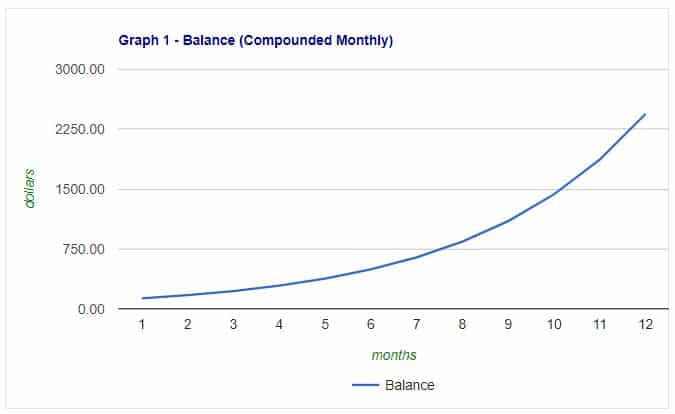
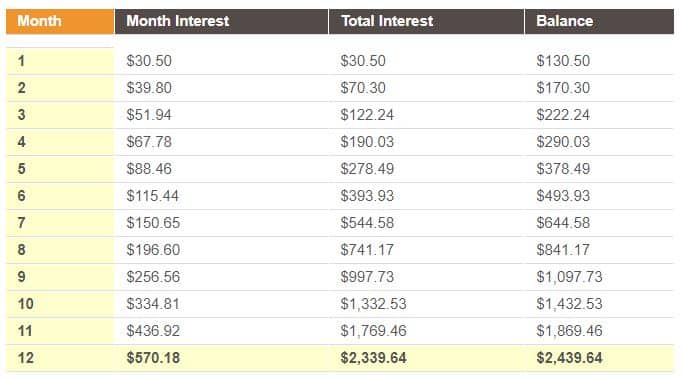
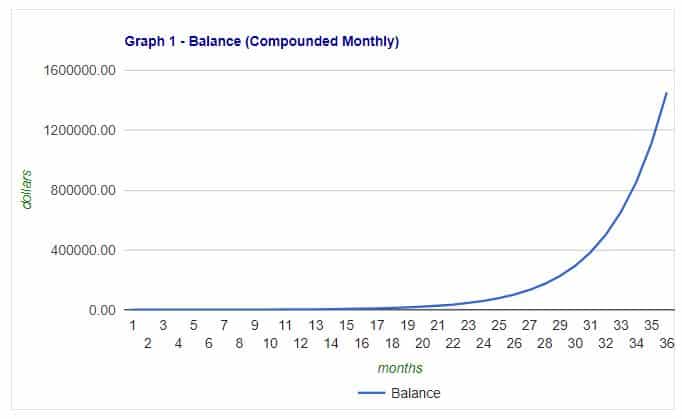
Long-term forex trading often proves more dependable than short-term day trading. By trading with low leverage over extended periods, you could potentially grow $100 into $1 million within three years. While this might sound extraordinary, it’s mathematically feasible under ideal conditions.
Of course, numerous factors can influence real-world outcomes, but the projections here are grounded in practical assumptions.
Most traders won’t achieve a jump from $100 to $1 million in three years, even if they follow this model precisely.
Many might opt to withdraw profits along the way. This example assumes no withdrawals until the $1 million goal is reached after three years. Staying committed to reinvesting gains is crucial for such exponential growth, alongside adapting to market changes and maintaining emotional control during downturns.

How Experts and Experienced Traders Trade Forex
Seasoned traders who utilize leverage often stick to strict risk management practices, limiting their trades to a leverage of 5:1 or even 3:1. This conservative approach is a key factor in their consistent success.
Another reason experienced traders profit in forex is their financial stability. They only trade with capital they can afford to risk, avoiding emotional stress.
With stable finances, they properly fund their trading accounts, reducing the temptation to over-leverage.
This financial balance helps them avoid emotional trading, which in turn lowers the likelihood of preventable errors and losses.
Mastering technical and fundamental analysis, understanding market sentiment, developing robust trading systems, and managing trading psychology are all vital. Equally important is ensuring your account is adequately capitalized and that you trade with prudent leverage to sustain long-term profitability and minimize unnecessary risks.
For beginners, developing these vital skills starts with a structured learning path. Begin by immersing yourself in educational resources: reputable books, online courses, and webinars from established financial institutions. Focus on understanding the basics of technical analysis, such as identifying support and resistance levels, interpreting candlestick patterns, and using common indicators like moving averages or the Relative Strength Index (RSI). Simultaneously, learn about fundamental analysis by following economic calendars and understanding how key economic data (e.g., interest rate decisions, inflation reports) can impact currency values.
To build robust trading systems, start by backtesting simple strategies on historical data to see how they would have performed. Then, forward-test them on a demo account to gain real-time experience without financial risk. Managing trading psychology is perhaps the most challenging aspect; it involves developing emotional discipline, sticking to your trading plan regardless of short-term outcomes, and learning from both wins and losses without letting emotions dictate decisions. Practicing mindfulness and maintaining a trading journal can be powerful tools in this journey, helping you to identify and mitigate psychological biases that often lead to poor trading choices.
Your chances of failure as a trader drop significantly when you start with an appropriate minimum capital. Small accounts like $100 often push traders toward excessive leverage, heightening risk.
For this reason, opening a tiny trading account with expectations of massive returns is not recommended.
Adequately funding your account and using low leverage can cap your losses at a level you can handle without distress.
This approach ensures your peace of mind remains intact, and you retain enough capital to keep trading over the long haul. Building your account gradually while learning from each trade also helps in developing resilience and a deeper understanding of market behavior.
Conclusion
Be wary of exaggerated promises from forex trading brokers claiming you can turn $100 into millions quickly.
While they may promote trading large volumes through leverage, they often fail to highlight the severe consequences if the market moves against you.
Although it’s theoretically possible to grow $100 into $10,000 or more, analyzing the required rates of return reveals how challenging and often unrealistic this goal is.
Forex firms that lure you with promises of enormous returns on minimal investments in short timeframes are typically misleading you, aiming to profit from your lack of experience.
Forex trading is far from a quick path to riches.
Success demands knowledge, dedication, and intelligent decision-making in every trade you execute.
Choosing the right trading strategy with careful consideration is essential for long-term growth. Always prioritize education and practice over chasing unrealistic gains, as this builds a foundation for sustainable trading.
Consider adopting swing trading as a strategy. Trading on higher timeframes, such as H1 and H4, typically requires less daily attention and can yield significant pip gains. This approach involves holding positions for several days or weeks to capture larger price movements, making it suitable for those looking to turn $100 into $1000 or more without constant market monitoring. To identify swing trading opportunities, traders often look for clear trends, support and resistance levels, and candlestick patterns like engulfing bars or pin bars. Indicators such as the Relative Strength Index (RSI) or Moving Average Convergence Divergence (MACD) can also help confirm entry and exit points. If you analyze charts effectively on these levels.
Patience is key—don’t rush the process. Choose a strategy and test it thoroughly on a demo account for several weeks. If it proves successful and suits your style, stick with it. If the results fall short, don’t hesitate to abandon it and explore a more effective approach.
Finding the ideal strategy isn’t straightforward. It might take months of trial and error to identify a method that aligns with your goals and risk tolerance. Once you find it, commit to consistent application.
By diligently applying a proven strategy over several months, you’ll refine your skills. This disciplined practice is the most reliable path to success in the forex market, helping you adapt to changing conditions and improve decision-making.