Best Canadian ETFs for Beginners (2026)
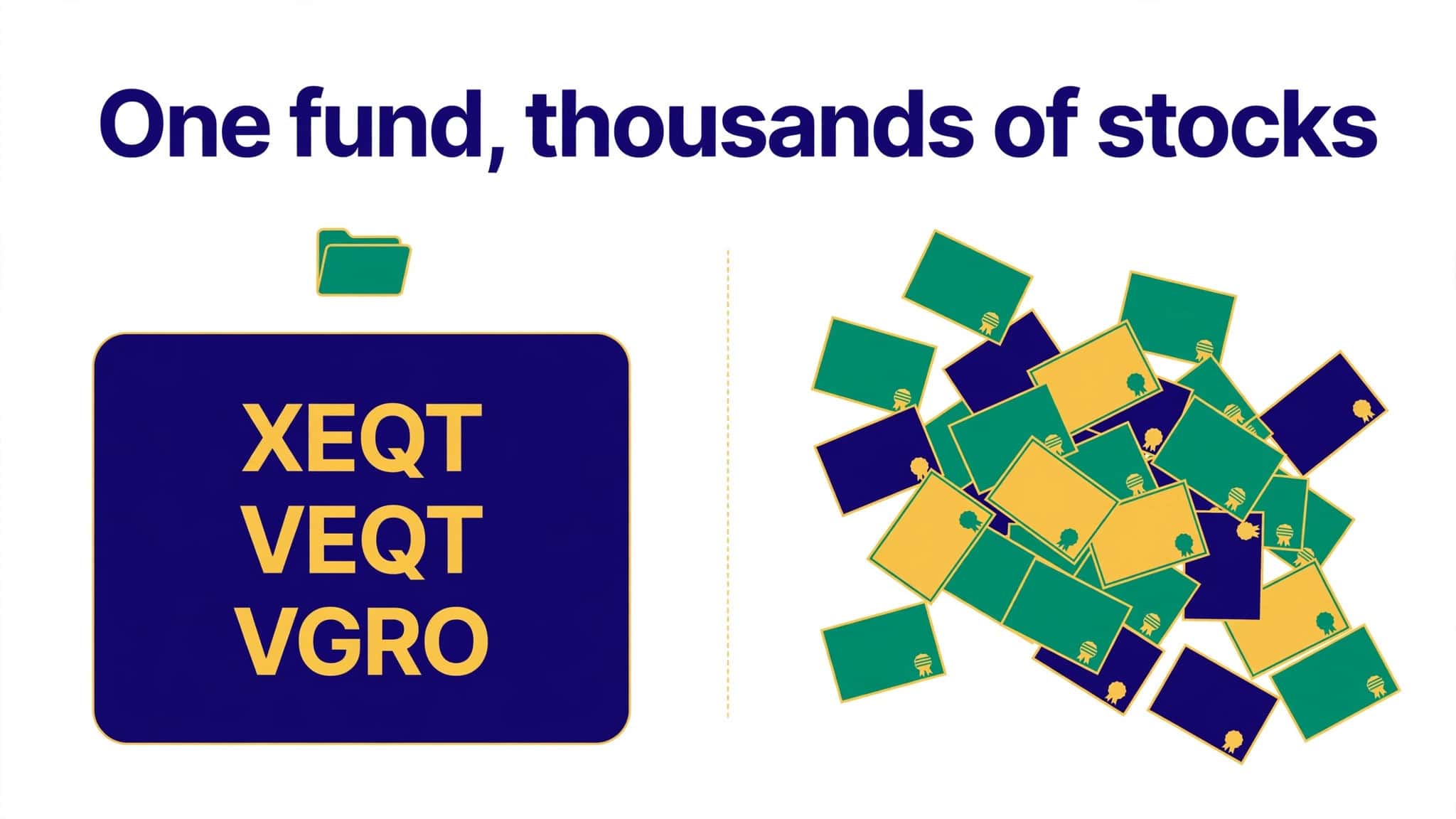
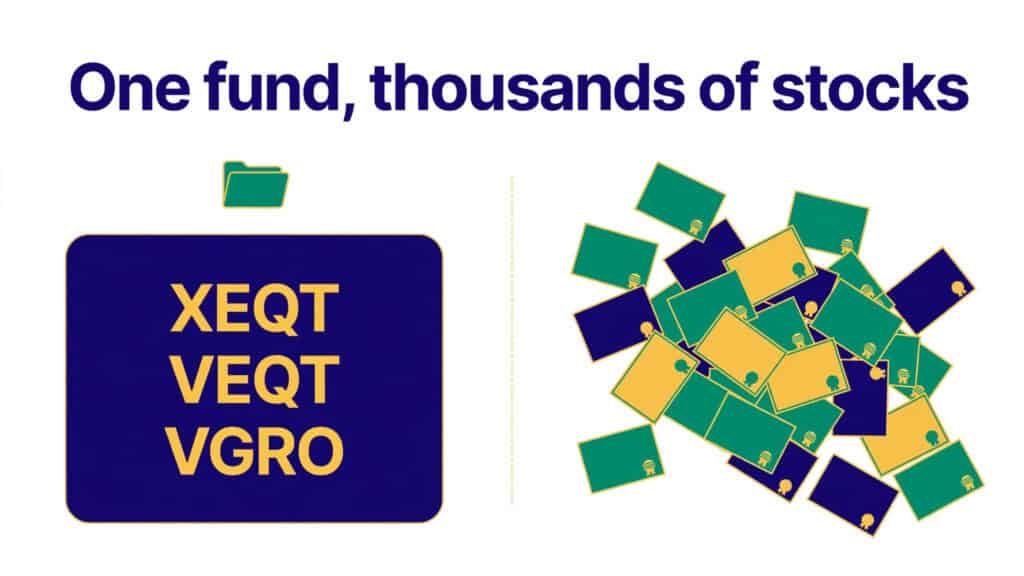
TL;DR: If you buy exactly one ETF, make it XEQT — a single fund that holds roughly 8,000+ global stocks for about 0.20% per year, so you never have to think about rebalancing. VEQT is the runner-up and essentially the same idea from Vanguard (its management fee was cut in late 2025, so its MER should keep falling). Nervous about market swings? Pick VGRO instead: it’s the same global portfolio with ~20% bonds mixed in to smooth the ride. Skip the fancy stuff until you’ve been investing for a year.
The $200/month case for starting today
Here’s a concrete example, because vague advice like “start early” means nothing without numbers.
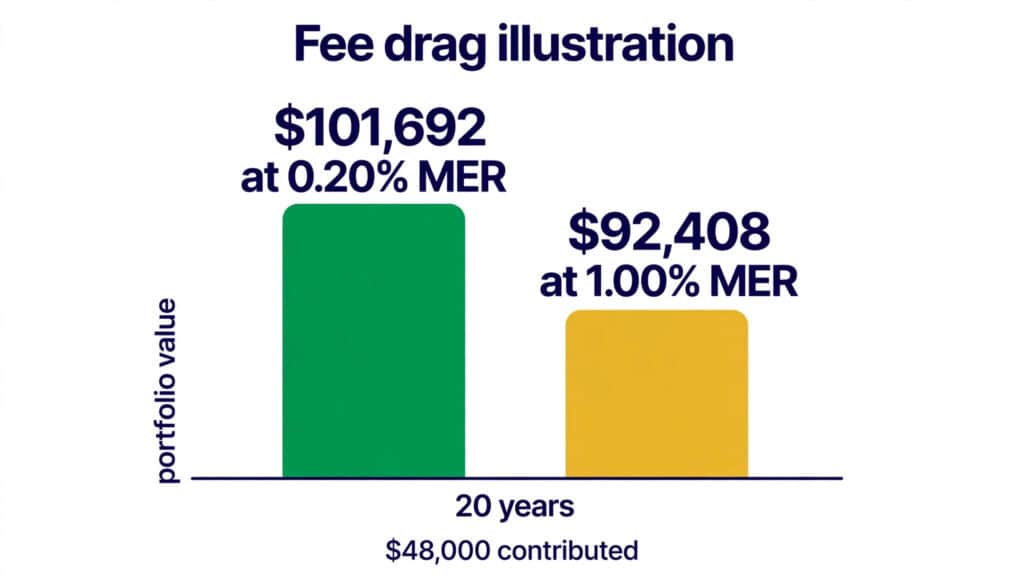
Say you put $200 a month into a TFSA every month for 20 years. That’s $48,000 of your own money. If the market returns 7% a year and your fund charges a 0.20% fee, the math lands at roughly $101,700 at the end (we’ll show the full arithmetic below). Now do the same thing with a 1.00% fee — the kind of fee Canadian mutual funds have happily charged for decades — and you end up with about $92,400. Same contributions, same market returns, $9,300 less in your pocket. That’s nearly 20% of everything you contributed, vaporized by 0.80% per year in extra fees.
This is the entire game for beginners: pick one low-fee, globally diversified ETF, buy it inside a TFSA, and keep buying it. Everything in this article is a different flavor of that same decision. You don’t need twelve ETFs. You need one, and you need the fee to be low.
How we picked these
- Fees: Every fund here charges 0.24% per year or less. That’s the whole point — fee drag compounds, and beginners get hurt by fees long before they get hurt by the market.
- Diversification: Each ETF holds hundreds to thousands of securities. If one company blows up, your portfolio barely notices.
- CAD-listed: Everything trades on the Toronto Stock Exchange in Canadian dollars. No currency-conversion headache on every purchase.
- Liquidity: These are among the most heavily traded ETFs in Canada, with tight bid-ask spreads. Your buy order fills at a fair price.
- Beginner-proof: One-ticket solutions where possible. A beginner’s biggest risk isn’t picking the wrong fund — it’s panic-selling a confusing portfolio.
The comparison
| ETF | What it holds | MER | Approx. yield | Best for |
|---|---|---|---|---|
| XEQT (iShares Core Equity ETF Portfolio) | ~100% global stocks (~8,000+ holdings via underlying ETFs) | ~0.20% | ~1.6–2.0% | The one-fund answer for long horizons |
| VEQT (Vanguard All-Equity ETF Portfolio) | ~100% global stocks (~13,700 holdings via underlying ETFs) | ~0.24% reported (fee cut to 0.17% mgmt fee in late 2025) | ~1.3–1.8% | Vanguard loyalists; arguably the cheapest soon |
| VFV (Vanguard S&P 500 Index ETF) | ~500 large-cap US stocks | 0.09% | ~0.85% | A cheap, focused US-growth satellite |
| XEI (iShares S&P/TSX Composite High Dividend Index ETF) | 75 high-dividend Canadian stocks | ~0.23% | ~3.4–3.6% | Canadians who want dividend income now |
| VGRO (Vanguard Growth ETF Portfolio) | ~80% global stocks, ~20% bonds | ~0.22% reported (fee cut to 0.17% mgmt fee in late 2025) | ~1.8–2.2% | Nervous beginners who want a smoother ride |
| ZAG (BMO Aggregate Bond Index ETF) | ~1,855 Canadian investment-grade bonds | 0.09% | ~3.4–3.5% | The bond half of a DIY two-fund portfolio |
Yields are trailing/indicative figures as of mid-2026 and move with prices — treat them as rough guides, not promises. MERs are the most recently reported figures; issuers adjust management fees periodically.
The detailed breakdown
1. XEQT — the default answer
What it is: XEQT is BlackRock’s all-in-one equity portfolio. One purchase gives you roughly 26% Canadian stocks, 44% US stocks, 25% international developed stocks, and 5% emerging markets, spread across about 8,000–9,000 underlying holdings. It rebalances itself, so your country mix never drifts. Inception date: August 2019. It has grown into one of Canada’s most popular ETFs precisely because it’s boring in the best way.
Why beginners love it: There is genuinely nothing to do. You buy XEQT, the fee (~0.20% per year) is deducted inside the fund, and the fund keeps your global allocation on track forever. No rebalancing spreadsheet. No “should I buy more Canada or more US this quarter” decisions.
Who it’s NOT for: If market drops make you want to sell everything, XEQT won’t protect you — it’s 100% stocks, and in 2022 it fell roughly 11% like the rest of the equity world. Also, if you need steady cash flow now (retirees, for example), the ~1.6–2.0% distribution yield won’t pay any bills.
- Pros: Maximum simplicity; huge diversification; very low fee for a one-ticket portfolio; massive liquidity.
- Cons: Zero downside cushion in a crash; the dividend yield is modest, so don’t buy it expecting income.
Verdict: Our pick for beginners with a 10+ year horizon who can leave the money alone.
2. VEQT — the Vanguard twin
What it is: VEQT is Vanguard’s answer to XEQT: an all-equity, globally diversified one-ticket portfolio holding roughly 13,700 stocks through Vanguard’s underlying index ETFs. Launched January 2019. The portfolio tilts toward Canada a bit more than XEQT does (~30%), which slightly reduces currency fluctuation for Canadian spenders and is mildly tax-efficient.
The fee story matters here: Vanguard cut VEQT’s management fee from 0.22% to 0.17% in November 2025, so the most recently reported MER of 0.24% should fall to around 0.19% once enough expenses roll through. XEQT has also been trimming — BlackRock cut its management fee to 0.17% and its reported MER sits around 0.19–0.20%. Realistically, these two are now priced within a couple of basis points of each other, and it’s not worth switching between them to chase $2 a year on a $10,000 account.
Who it’s NOT for: Same caveat as XEQT — it’s 100% equities, so expect the same gut-punch in a bear market. Distributions come annually rather than more frequently, which some income-oriented beginners dislike (though if you’re reinvesting, timing barely matters).
- Pros: Enormous diversification (~13,700 stocks); fee heading down to ~0.19%; Vanguard’s home-country tilt suits Canadian investors.
- Cons: Annual distributions only; identical crash behavior to XEQT; no bond cushion.
Verdict: A coin flip with XEQT. If you already like Vanguard, buy VEQT. If you already hold XEQT, don’t switch — the fee difference is now noise.
3. VFV — the cheap US engine
What it is: VFV tracks the S&P 500 — roughly 500 of the largest US companies — and does it for a MER of just 0.09%. It trades in Canadian dollars on the TSX, so there’s no conversion fee to buy it. The largest holdings are the names you’d expect: Nvidia (~7.6%), Apple (~7.1%), Alphabet (~5.9%), Microsoft (~5.4%) as of mid-2026. The yield is small (~0.85%), paid quarterly.
Why it’s attractive: Nine basis points is about as cheap as equity exposure gets. Over long periods, the S&P 500’s large-cap tech weighting has been the engine of global returns, and VFV is the simplest way for a Canadian to own it.
Who it’s NOT for: Beginners who want “one and done.” VFV is not diversified the way XEQT is — roughly a third of the index sits in about ten companies, and most of those are tech. If US mega-cap stocks have a bad decade, VFV has nowhere to hide. It’s a satellite holding, not a whole portfolio. Also, US withholding tax (15%) is taken from the dividends inside the fund before they reach you, and because VFV is a Canadian-listed ETF, you can’t recover it even inside an RRSP. That drag is small (it only applies to the ~0.85% distribution), but it exists.
- Pros: Cheapest fee on this list (0.09%); pure exposure to the world’s strongest equity market; CAD-traded.
- Cons: Heavy concentration in US mega-cap tech; no international or Canadian diversification; small but real US withholding-tax drag.
Verdict: Excellent as a piece of a portfolio — e.g., XEQT plus extra VFV if you want more US tilt. Poor as your only holding.
4. XEI — the Canadian dividend pick
What it is: XEI tracks the S&P/TSX Composite High Dividend Index: 75 of Canada’s highest-yielding large companies, each capped at 5% and each sector capped at 30%. Think banks, pipelines, and utilities — financials are about 36% of the fund, energy about 16%, utilities about 13%. The MER is about 0.23%, and it pays monthly distributions with an indicated yield around 3.4–3.6% (about $0.11–0.12 per unit per month recently).
Why it exists in a beginner portfolio: Some beginners find it psychologically easier to keep investing when cash lands in the account every month. That’s a legitimate reason, and XEI is the cheapest clean way to get it in Canada.
Who it’s NOT for: Anyone who thinks “dividends” means “safe.” XEI is 100% Canadian equities concentrated in three sectors. In a Canadian recession or an oil-price collapse, it will fall hard — possibly harder than a globally diversified fund. Its total return has historically lagged global equity portfolios; you’re trading growth for cash flow. And the monthly distribution is not guaranteed — it moves with the underlying dividends.
- Pros: Monthly income at a ~3.5% yield; low fee for a dividend strategy; Canadian dividends get favorable tax treatment in non-registered accounts (eligible dividend tax credit).
- Cons: Zero geographic diversification; heavy sector concentration (banks + energy + utilities ≈ 65%); lower long-term growth than global equity funds.
Verdict: Fine as a satellite for income-minded investors. If you’re decades from retirement, XEQT or VEQT will likely serve you better. When you’re ready to think seriously about income, our best covered call ETFs for monthly income guide covers the next step up the yield ladder.
5. VGRO — the training-wheels portfolio
What it is: VGRO is Vanguard’s 80/20 portfolio: roughly 80% global stocks and 20% bonds in a single fund, rebalanced automatically. Same management-fee cut as VEQT (down to 0.17% in late 2025; reported MER previously ~0.22%, expected to settle near ~0.19%). This is the fund for the beginner who reads “100% equities” and feels their stomach drop.
The honest trade: Bonds are a drag on returns in good years and a cushion in bad ones. Over very long horizons, 80/20 will trail 100/0 — that’s the price of sleeping better. For a beginner, that price is often worth paying, because the real destroyer of wealth isn’t a 0.2% fee gap, it’s panic-selling at the bottom of a crash and never getting back in. If a 20% bond allocation is what keeps you invested through 2022-style drawdowns, VGRO will beat the “optimal” portfolio you abandoned.
Who it’s NOT for: Young investors with iron stomachs and 20+ year horizons — for them, the bond drag is a real cost with no benefit. Also not for anyone who wants to manage their own stock/bond split (you can do that cheaper with VEQT + ZAG, below).
- Pros: Automatic rebalancing across stocks and bonds; meaningfully smoother ride than all-equity funds; same low-fee trajectory as VEQT.
- Cons: Lower expected long-term return than 100% equities; bonds currently yield modestly, so the 20% sleeve isn’t doing much heavy lifting.
Verdict: The best answer for nervous beginners. If you’re not sure you can stomach a 30–40% drawdown, don’t buy XEQT to prove something — buy VGRO.
6. ZAG — the bond building block
What it is: ZAG tracks the FTSE Canada Universe Bond Index: roughly 1,855 Canadian federal, provincial, and investment-grade corporate bonds with maturities over one year. MER of 0.09%. It pays monthly distributions (about $0.04 per unit, roughly a 3.4–3.5% annualized yield recently).
Why a beginner would care: ZAG isn’t a standalone beginner pick — it’s the DIY alternative to VGRO’s bond sleeve. A two-fund portfolio of VEQT + ZAG (or XEQT + ZAG) in whatever ratio matches your risk tolerance gives you the same structure as VGRO with slightly more control and a marginally lower blended fee. An 80/20 VEQT/ZAG mix, for example, has a blended MER around 0.17–0.18%.
Who it’s NOT for: Anyone looking for growth. Bonds are ballast, not an engine — ZAG’s long-term returns are a fraction of equity returns, and when interest rates rise, bond prices fall (ZAG had a rough stretch in 2022 for exactly this reason). Don’t buy it expecting your money to multiply.
- Pros: Cheapest bond exposure in Canada (0.09%); monthly distributions; genuine diversification from stocks in a crisis.
- Cons: Low expected returns; interest-rate risk; pointless as a standalone holding for young investors.
Verdict: Buy it only as the bond side of a two-fund portfolio. Pair with XEQT or VEQT.
The fee math, worked out properly
Let’s go back to the $200/month example and do the actual arithmetic, because “fees compound” is easy to say and easy to ignore.
Assumptions: $200 contributed at the end of every month for 20 years (240 contributions, $48,000 total), gross market return of 7.00% per year, fees deducted from returns.
Scenario A — 0.20% fee (what XEQT charges): Net return = 6.80% per year. Future value = $200 × [((1 + 0.068/12)^240 − 1) / (0.068/12)] = $101,692.
Scenario B — 1.00% fee (typical Canadian mutual fund territory): Net return = 6.00% per year. Future value = $200 × [((1 + 0.06/12)^240 − 1) / (0.06/12)] = $92,408.
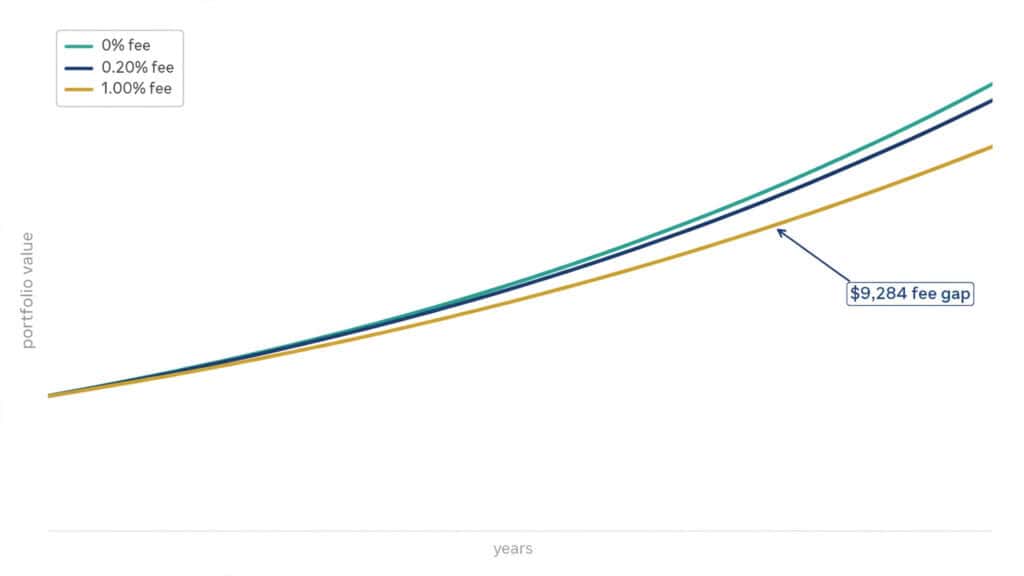
The difference: $9,284. That 0.80% per year in extra fees costs you nearly one-fifth of everything you contributed — and you’d never see a line item for it. The fee is silently skimmed from returns every single day.
For perspective, even the 0.20% fee isn’t free: a zero-fee portfolio at 7% would reach $104,185, so XEQT’s fee costs about $2,490 over 20 years. That’s the unavoidable price of the fund doing the work. The extra $9,284 in Scenario B is the avoidable part — and avoiding it is as simple as buying an ETF instead of a mutual fund.
How to actually buy your first ETF
Step 1 — Open a self-directed account. Two solid options for Canadians: Wealthsimple (self-directed account with $0 commissions, fractional shares from $1, and recurring buys — genuinely the easiest on-ramp) and Questrade (commission-free ETF purchases; selling costs the standard commission, and small ECN fees can apply). Both offer TFSAs, RRSPs, and other registered accounts with no annual account fees. If you’re comparing brokers more broadly, our forex broker reviews cover the trading-oriented side of the market.
Step 2 — Pick the account type. For most beginners, the TFSA is the right first account: your investments grow tax-free and withdrawals are tax-free too. (The 2026 annual contribution limit is $7,000; your lifetime room depends on your age and residency history — check your CRA My Account.) An RRSP makes more sense once you’re earning a solid income and want the tax deduction now. One paragraph of guidance: if you’re early-career or unsure, TFSA first. You can always open an RRSP later.
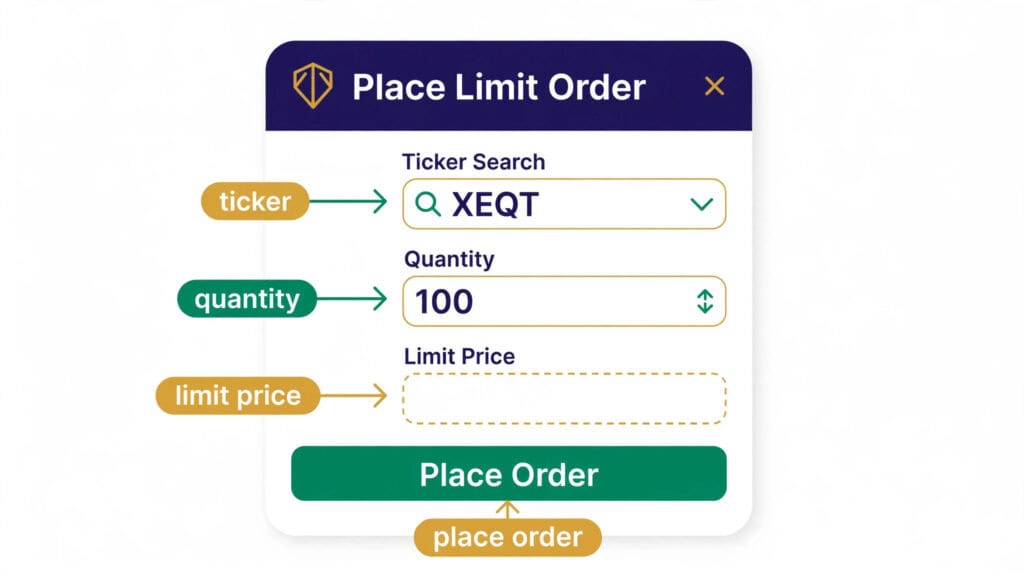
Step 3 — Place the order. Fund the account, search the ticker (e.g., XEQT), and place a limit order during market hours (9:30 a.m.–4:00 p.m. ET) at or near the current price. With Wealthsimple’s fractional shares you can invest any dollar amount; elsewhere, buy whole shares — with XEQT around $45 per unit, $200 buys about four shares with a bit left over. Then set up an automatic recurring purchase so it happens without you thinking about it. That automation matters more than which ticker you picked.
FAQ
How much money do I need to start? Less than you think. With fractional shares (Wealthsimple lets you buy from $1), you can start with whatever’s in your pocket. Practically, $100–$200 a month is a great rhythm — it builds the habit, and as the math above shows, the habit is what compounds. Don’t wait until you have “enough.” Time in the market beats timing, and it beats waiting.
TFSA or RRSP — which first? For most beginners: TFSA. Tax-free growth, tax-free withdrawals, and you get the contribution room back the following year if you withdraw. The RRSP’s tax deduction is most valuable when you’re in a higher tax bracket, which for many beginners is a few years away. The exception: if your employer matches RRSP contributions, contribute enough to grab the full match first — that’s an instant 50–100% return nothing else can touch.
What about US withholding tax on VFV? VFV holds US stocks, and the US takes 15% of the dividends before they reach the fund. Because VFV is a Canadian-listed ETF, you can’t recover that tax — not in a TFSA, and not even in an RRSP (the treaty exemption only covers US-listed securities held directly). In practice this only bites the distribution yield (~0.85%), so the drag is roughly 0.13% per year. Worth knowing, not worth losing sleep over.
When should I sell? Almost never, if you picked correctly. The honest answer: sell when your life changes, not when the market does. Rebalancing once a year, shifting toward bonds as you age, or needing the money for a house down payment are reasons to sell. A scary headline is not. Every study of investor behavior says the same thing — the average investor’s returns lag the funds they own, because they buy high and sell low. Your edge as a beginner is simply refusing to play that game.
Should I buy XEQT or VEQT? Whichever one you’ll actually keep buying. They’re 95% identical in outcome: global stocks, automatic rebalancing, fees now within a hair of each other (~0.19–0.20%). Flip a coin if you must. The wrong choice is spending three months researching and buying nothing.
What comes after my first ETF? Once your core holding is on autopilot and you’ve survived your first market dip without selling, you can think about the income side of the equation. That’s the natural progression: growth first, income later. Our generate monthly income with Canadian covered call ETFs guide picks up exactly where this article leaves off.
Final verdict
Ranked, no hedging:
- XEQT — the best single purchase for a beginner with a long horizon. One fund, ~8,000 stocks, ~0.20% fee, zero maintenance.
- VEQT — functionally tied with XEQT; buy it if you prefer Vanguard. Its fee cut makes it arguably the cheapest one-ticket option going forward.
- VGRO — the right answer if market volatility keeps you up at night. An 80/20 portfolio you can actually stick with beats a 100/0 portfolio you abandon.
- VFV — a superb satellite for extra US exposure at 0.09%, but not a whole portfolio.
- XEI — a reasonable income satellite for Canadians who want monthly dividends; understand the sector concentration before you buy.
- ZAG — the bond half of a DIY portfolio, full stop.
The concrete starter portfolio: open a TFSA at Wealthsimple or Questrade, set up a $200/month automatic purchase of XEQT (or VGRO if you’re nervous), and don’t look at it more than twice a year. That single decision, repeated for 20 years, puts you ahead of the vast majority of Canadian investors — most of whom are still paying 1%+ for mutual funds that do less. When your portfolio is large enough that you start thinking about living off it, come back and read our best covered call ETFs for monthly income guide. Growth first, income later — in that order.
Educational disclaimer: This article is for educational and informational purposes only and is not financial advice, investment advice, or a recommendation to buy or sell any security. All investments carry risk, including the possible loss of principal. Past performance does not guarantee future results. Consider your own financial situation, goals, and risk tolerance, and consider speaking with a licensed financial professional before making investment decisions.
Tax disclaimer: This article discusses Canadian tax concepts (TFSAs, RRSPs, dividend tax credits, withholding tax) in general terms only and is not tax advice. Tax rules change and individual situations vary. Consult a qualified tax professional or accountant about your specific circumstances.
Affiliate disclosure: This article may contain affiliate links. If you open an account through one of our links, forexcryptohub.com may earn a commission at no extra cost to you. This helps support our independent research and does not influence which products we recommend. Read more on our homepage.